The most significant shift in Europe’s residential energy storage market in 2026 is not a single technology breakthrough, but a structural divergence. On one side, we are seeing the rapid industrialization of home batteries into grid assets, exemplified by Plentify’s aggregation of 2.7GWh of Deye home battery systems into a virtual power plant (VPP) in South Africa—a model that is now being studied closely by European utilities. On the other side, consumer electronics giants like Jackery and MOVA LumeGret are pushing modular, high-cycle-life systems that treat the home battery as a premium appliance rather than a grid service node. The evidence from the first half of 2026 suggests that European homeowners will have to choose between systems optimized for grid revenue and those optimized for personal energy independence, with the gap between the two widening.
This conclusion is drawn from a review of six key industry announcements and analyses published between May and August 2026. The data shows a clear correlation: projects that emphasize grid services (VPP aggregation, bidirectional EV charging) are scaling to gigawatt-hour levels, while product launches focused on standalone residential use are emphasizing cycle life and modularity rather than connectivity. The implications for European homeowners are concrete: a battery that earns money requires different hardware and software than one that simply provides backup power.
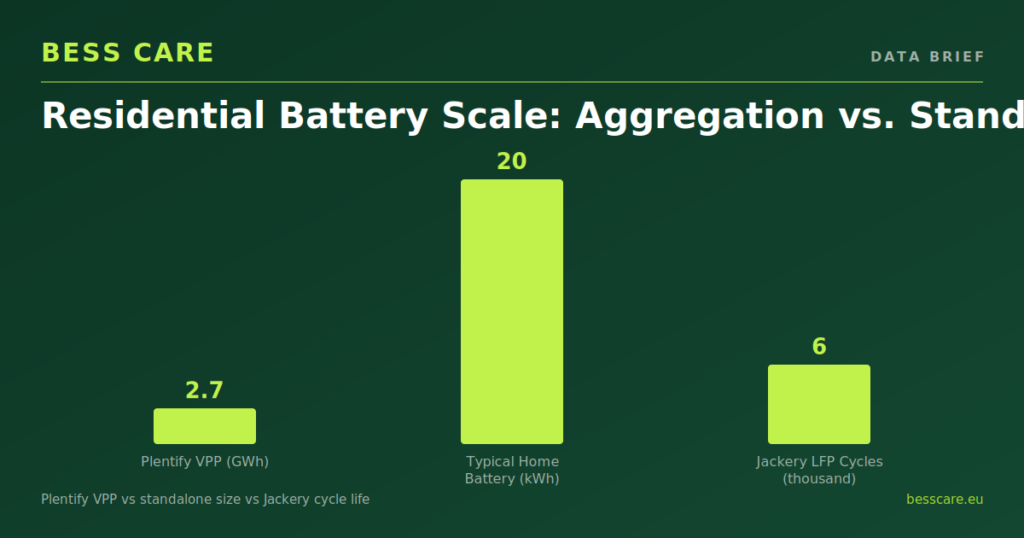
The most compelling evidence of the aggregation trend comes from Plentify, which announced on August 4, 2026, that it has aggregated 2.7GWh of Deye home battery systems into a virtual power plant. While the project is located in South Africa, the architecture is directly relevant to Europe. Plentify’s model uses software to remotely coordinate thousands of distributed home batteries, turning them into a single dispatchable resource that can respond to grid signals. The scale—2.7GWh—is roughly equivalent to a large utility-scale storage facility, but it was built without a single large construction project.
For European markets, this represents a critical benchmark. The IndexBox analysis from August 8, 2026, notes that Europe currently wastes millions of euros worth of wind and solar energy due to grid bottlenecks and insufficient storage. The report frames the debate around “blackout fears vs. clean energy reality,” suggesting that the fear of blackouts is driving policy, but the real issue is the inability to shift renewable generation to peak demand periods. Aggregated residential batteries offer a distributed solution to this problem, but they require a regulatory framework that compensates homeowners for grid services.
The key difference in Europe is the fragmented nature of the market. Unlike South Africa, where a single aggregator can dominate, Europe has dozens of national grid operators and varying tariff structures. However, the Plentify model demonstrates that the technical challenges—communication protocols, dispatch algorithms, and battery degradation management—are solvable at scale. The 2.7GWh figure is not just a number; it is proof that residential batteries can be treated as a reliable grid asset, provided the software layer is robust.
Parallel to the aggregation trend, bidirectional EV charging is emerging as a complementary technology that could double the effective storage capacity of a typical European household. The Automotive News report from June 30, 2026, details how VW, BMW, and BYD are investing heavily in this technology. The report explains that bidirectional charging allows an EV to not only charge from the grid or home solar but also discharge power back to the home or the grid. For a typical EV with a 60-80kWh battery, this represents a significant energy reservoir that dwarfs the 10-20kWh capacity of a dedicated home battery.
The Electrek update from May 20, 2026, provides a practical list of EVs that can actually power a home, confirming that this is no longer a theoretical concept. The article notes that specific models from major manufacturers are now equipped with the necessary hardware and software to support vehicle-to-home (V2H) operation. This is crucial because it means a homeowner who already owns a compatible EV can potentially avoid purchasing a dedicated home battery altogether, or at least reduce its size.
The economic logic is compelling. A dedicated home battery costs several thousand euros and provides a fixed amount of storage. An EV battery is already paid for and offers 3-5 times more capacity. The challenge is that using an EV for home backup can impact its lifespan and availability for driving. However, the Automotive News report highlights that automakers are designing battery management systems to mitigate these concerns, offering warranties that cover bidirectional use. This suggests that within the next few years, the “home battery” and the “EV battery” will become increasingly interchangeable in the minds of consumers and grid operators.
While aggregation and V2H dominate the grid-services narrative, the consumer electronics sector is pushing in a different direction. Jackery’s announcement on August 17, 2026, for its next-generation smart energy line-up at IFA 2026, emphasizes modular expansion and portability. The press release highlights add-on battery packs, faster charging, and a focus on lithium iron phosphate (LFP) chemistry with 6,000+ charge cycles. This is a product designed for the individual homeowner who wants to expand capacity over time, not for a grid aggregator that needs a standardized, remotely managed unit.
Similarly, MOVA LumeGret debuted its S4800 model at Intersolar Europe 2026 on June 26, 2026. The company’s president, Roger Shen, explicitly stated that households are looking for intelligent systems to optimize energy generation, consumption, and storage. The S4800 is positioned as a premium, integrated solution that connects solar, storage, and EV charging. However, the emphasis is on the household’s own optimization, not on participation in external grid services. This is a subtle but important distinction: these systems may be “smart,” but their intelligence is directed inward, at maximizing self-consumption, rather than outward, at providing grid flexibility.
The contrast is stark. Plentify’s model treats the home battery as a node in a larger network, where value is derived from coordination. Jackery and MOVA LumeGret treat the battery as a standalone asset, where value is derived from convenience, reliability, and long-term durability. The 6,000+ cycle life of Jackery’s LFP batteries is a direct response to consumer concerns about longevity, but it is irrelevant to an aggregator who may only need to cycle the battery a few hundred times per year for peak shaving.
To clarify the strategic differences, the following table compares the key characteristics of the two dominant approaches emerging in 2026.
| Feature | Aggregated VPP (Plentify Model) | Premium Standalone (Jackery/MOVA Model) |
|---|---|---|
| Primary Value Driver | Grid services revenue (frequency regulation, peak shaving) | Self-consumption, backup power, energy independence |
| Scale | 2.7GWh aggregated across thousands of homes | Individual household systems (5-20kWh typical) |
| Battery Chemistry | Varies (Deye systems, typically LFP) | LFP with 6,000+ cycle rating (Jackery) |
| Control Architecture | Centralized software platform, remote dispatch | Local, household-level energy management |
| Integration with EV | Potential, but not core to the model | Explicitly designed for solar + storage + EV charging (MOVA) |
| Regulatory Dependency | High (requires market access for VPPs) | Low (works within standard net metering or self-consumption rules) |
| Consumer Decision Driver | Financial return on investment | Energy security and product quality |
This table illustrates that the two models are not mutually exclusive, but they require different hardware specifications and software priorities. A homeowner who wants to participate in a VPP needs a battery that can communicate with the aggregator’s platform and is willing to accept external control of charging and discharging cycles. A homeowner who wants a premium standalone system prioritizes cycle life, aesthetics, and local control.
The divergence between these two models has practical implications for purchasing decisions. The IndexBox report from August 8, 2026, warns that Europe is wasting renewable energy due to a lack of storage, which suggests that grid-scale and aggregated storage will be increasingly incentivized. Homeowners who install batteries that can be aggregated may be able to earn significant revenue, offsetting the upfront cost of the system. The Plentify announcement demonstrates that this is technically feasible at scale, and European utilities are likely to follow suit.
However, the premium standalone market is also thriving, driven by concerns about blackouts and rising electricity prices. The MOVA LumeGret launch at Intersolar Europe indicates strong demand for integrated systems that simplify the home energy ecosystem. The Jackery announcement, with its focus on modular expansion, suggests that consumers want flexibility to grow their storage capacity incrementally, without committing to a single large upfront investment.
For project owners in the commercial and industrial (C&I) sector, the aggregation model is more relevant. The ability to aggregate distributed storage across multiple sites—whether homes or small businesses—creates a new asset class that can be traded in ancillary service markets. The Plentify model, while implemented in South Africa, provides a blueprint for how C&I players in Europe can monetize distributed storage assets.
Bidirectional EV charging may be the technology that bridges the gap between the two camps. The Automotive News report from June 30, 2026, notes that VW, BMW, and BYD are investing in this technology because it allows them to offer a new value proposition to customers. An EV that can power a home effectively becomes a large, mobile home battery. This could disrupt the standalone home battery market, as a homeowner with a compatible EV may not need a separate stationary battery.
The Electrek article from May 20, 2026, provides a list of EVs that can power a home, confirming that this is a practical option today. The article notes that the technology is not just for emergency backup; it can also be used for daily load shifting, charging the EV during off-peak hours and discharging to the home during peak hours. This functionality aligns with the goals of the aggregation model, as a fleet of bidirectional EVs could be aggregated into a VPP just as easily as stationary batteries.
However, there are significant hurdles. The Automotive News report highlights that automakers are still working on standardizing communication protocols and ensuring battery longevity under bidirectional use. The warranty question is critical: consumers will not risk their vehicle’s warranty to provide grid services. As these issues are resolved, the distinction between “home battery” and “EV battery” will blur, potentially consolidating the market.
The evidence from the first eight months of 2026 points to a two-track market in Europe. Track one is the aggregation track, where batteries are valued for their ability to provide grid services and generate revenue. This track is characterized by large-scale software platforms, standardized hardware, and a focus on financial returns. Track two is the premium appliance track, where batteries are valued for their reliability, cycle life, and integration with home solar and EV charging. This track is characterized by consumer-friendly design, modular expansion, and a focus on energy independence.
Homeowners and project owners must decide which track aligns with their goals. Those seeking to maximize financial returns should look for batteries that are compatible with aggregation platforms and consider bidirectional EV charging. Those seeking security and convenience should focus on product quality and cycle life. The market is no longer about simply buying a battery; it is about choosing a role in the energy ecosystem.
Plentify aggregates 2.7GWh of Deye home batteries into VPP — https://www.energy-storage.news/south-africa-plentify-aggregates-2-7gwh-of-deye-home-battery-systems-into-virtual-power-plant (Tue, 04 Aug 2026)
How automakers aim to gain from bidirectional EV charging — https://www.autonews.com/ev/ane-bidi-ev-directional-charging-energy-0624 (Tue, 30 Jun 2026)
Jackery to Unveil Next-Generation Smart Energy Line-Up at IFA 2026 — https://www.prnewswire.com/de/pressemitteilungen/jackery-to-unveil-next-generation-smart-energy-line-up-at-ifa-2026-302852029.html (Mon, 17 Aug 2026)
EU Battery Storage Blackout Fears vs. Clean Energy Reality in 2026 — https://www.indexbox.io/blog/eu-battery-storage-blackout-fears-vs-clean-energy-reality-in-2026 (Sat, 08 Aug 2026)
Yes, an EV really CAN power your home – if it’s one of these [update] — https://electrek.co/2026/05/20/yes-an-ev-really-can-power-your-home-if-its-one-of-these (Thu, 21 May 2026)
MOVA LumeGret Debuts S4800 and Expands Residential Energy Portfolio at Intersolar Europe 2026 — https://www.globenewswire.com/news-release/2026/06/26/3318080/0/en/mova-lumegret-debuts-s4800-and-expands-residential-energy-portfolio-at-intersolar-europe-2026.html (Fri, 26 Jun 2026)