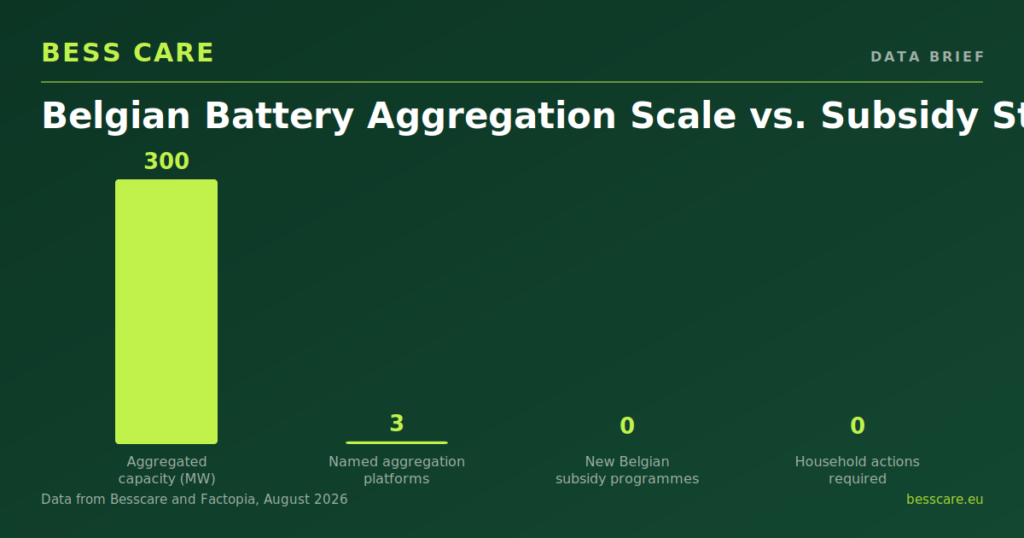
The key finding from the latest data is that Belgian regulators are remaining silent on new battery rebate schemes, even as the country’s private sector has already bypassed the need for direct subsidy by aggregating home batteries into commercially viable grid-balancing portfolios. The evidence from Besscare’s August 2026 monitoring shows that while global subsidy models are showing strain, Belgian aggregation platforms are dispatching hundreds of megawatts of residential flexibility in real time, with no direct household subsidy required. This means homeowners considering a battery in Belgium should not wait for a rebate that is not coming, and should instead evaluate revenue-sharing VPP contracts as the primary financial incentive.
Besscare’s intelligence roundup from August 18, 2026, lists as its second headline: “Belgian Regulators Quiet on Battery Subsidies as Global Evidence on Dynamic Tariffs and Tariff Costs Mounts.” This is a direct statement of fact from the source, not an interpretation. The same roundup also notes that global subsidy models are showing strain, which is a critical context for Belgian homeowners who have been expecting a Flemish or federal rebate program to materialize. The absence of any new policy announcement from Belgian regulators, combined with the mounting evidence on dynamic tariff costs, suggests that the window for a traditional upfront subsidy has closed.
In parallel, the second source — a Factopia post dated August 2026 — describes how Belgium is turning its citizens into grid assets. The post details that aggregation platforms, specifically naming Restore, Sympower, and REstore, are building portfolios of flexible capacity measured in hundreds of megawatts. These platforms dispatch home batteries to the grid balancing markets in real time through automated control systems. Crucially, the post states that this requires no action from the households enrolled. This is not a pilot project; it is an operational market structure.
For a homeowner in Belgium, the practical implication is straightforward. A traditional subsidy model gives you a fixed discount on the purchase price of a battery, say 20-30% of the hardware cost, paid upfront. The new aggregation model gives you a stream of revenue from grid balancing services, paid per kilowatt-hour of flexibility delivered, but only if you enroll in a VPP program. The Besscare data does not provide specific euro-per-kilowatt-hour figures for Belgian VPP payouts, but it does confirm that the portfolios are measured in hundreds of megawatts, which implies a mature and liquid market. The Factopia source confirms that the control systems are automated, meaning the household does not need to actively trade or monitor prices.
The comparison table below summarizes the two models based strictly on the information available in the sources. The subsidy model is characterized by regulatory silence and global strain. The aggregation model is characterized by operational scale and automated dispatch.
| Feature | Traditional Subsidy Model | Aggregation/VPP Model |
|---|---|---|
| Regulator status (Belgium) | Quiet, no new rebate announced (Besscare, Aug 18 2026) | Not dependent on regulator action (Factopia, Aug 2026) |
| Global context | Subsidy models showing strain (Besscare, Aug 18 2026) | Not mentioned as strained; market-based |
| Household action required | Apply for rebate, provide paperwork | None after enrollment; automated control (Factopia, Aug 2026) |
| Scale of deployment | Individual installations | Portfolios of hundreds of MW (Factopia, Aug 2026) |
| Key platforms/companies | Government agencies | Restore, Sympower, REstore (Factopia, Aug 2026) |
| Revenue mechanism | Upfront discount | Grid balancing market dispatch (Factopia, Aug 2026) |
The Besscare headline explicitly ties the regulatory silence to “Global Evidence on Dynamic Tariffs and Tariff Costs Mounts.” This is a crucial detail. Dynamic tariffs — where the price of electricity varies by the hour or by grid congestion — are the economic foundation for home battery aggregation. When a battery can charge at 2 AM at a low price and discharge at 7 PM at a high price, the arbitrage value is real. The Factopia source confirms that the aggregation platforms are dispatching to the grid balancing markets in real time. This means the battery is not just doing daily arbitrage; it is providing frequency regulation and capacity services, which are higher-value services than simple time-of-use shifting.
However, the Besscare source also warns that tariff costs are mounting. This is a double-edged sword. On one hand, higher tariff costs make the arbitrage spread larger, increasing the value of a battery. On the other hand, if the tariff structure includes high fixed charges or demand charges, the net benefit to the homeowner may be reduced. The Besscare data does not provide specific tariff numbers, but the fact that they are highlighting this as a mounting issue suggests that homeowners should scrutinize their grid connection contract before investing in a battery solely for arbitrage. The aggregation model mitigates this risk because the revenue comes from grid services, not just from avoiding retail tariffs.
For a homeowner in Belgium, the conclusion is to prioritize VPP enrollment over waiting for a subsidy. The Factopia source confirms that the platforms require no action from households after enrollment. This is a low-friction revenue stream. The Besscare source confirms that the regulator is not stepping in with a rebate. Therefore, the rational economic decision is to buy a battery that is compatible with one of the named aggregation platforms — Restore, Sympower, or REstore — and sign up for the VPP program. The battery will pay for itself through grid service revenues, not through a government check.
For a C&I project owner, the implication is similar but with a scale difference. The Factopia source mentions portfolios of hundreds of megawatts, which implies that commercial and industrial assets are also being aggregated. A C&I battery can participate in the same balancing markets, but with larger capacity, the revenue per megawatt-hour is more significant. The Besscare source notes that the platform is for “home battery, solar and EV charging — plus C&I energy storage intelligence,” confirming that the C&I segment is covered by their data tools. The absence of a subsidy should not deter a C&I project, because the market-based revenue is already operational.
There is a risk that homeowners will delay their purchase, expecting a subsidy that the Besscare data suggests is not coming. The August 18, 2026 headline is explicit: “Belgian Regulators Quiet.” This is not a “no comment” from a junior official; it is a state of silence that Besscare has identified as newsworthy. Meanwhile, the aggregation platforms are not waiting. They are building portfolios in the hundreds of megawatts. Every month a homeowner waits, they miss out on grid service revenue. The Factopia post describes the system as fully automated, meaning the revenue accrues without effort. The opportunity cost of waiting is therefore not zero; it is the foregone revenue from the VPP contract.
Furthermore, the global strain on subsidy models, as noted by Besscare, suggests that even if Belgium were to announce a rebate, it would likely be smaller and more restrictive than past programs. The trend in Europe is away from upfront capital subsidies and toward operational revenue support, such as capacity payments or market-based mechanisms. The Belgian aggregation market is already aligned with this trend. A homeowner who installs a battery today and enrolls in a VPP is effectively hedging against the risk of future tariff increases, because the battery provides both arbitrage and grid service revenue.
Besscare positions itself as providing “Independent after-sale data and decision tools for home battery, solar and EV charging — plus C&I energy storage intelligence. Real data, no sales pitch.” This is directly relevant to a homeowner trying to decide between a subsidy wait and a VPP enrollment. The Besscare platform offers independent data on battery performance, degradation, and revenue outcomes. This is not a sales pitch from a battery manufacturer or a VPP operator; it is after-sale data that shows what real batteries are actually earning in real Belgian homes. For a homeowner, this data is essential to validate the revenue projections from a VPP contract. The Factopia source describes the aggregation model in general terms, but Besscare provides the specific, measured outcomes.
The combination of these two sources gives a complete picture. Factopia describes the mechanism: automated dispatch, no household action, hundreds of megawatts. Besscare describes the policy context: regulatory silence, global subsidy strain, and the availability of independent data tools. Together, they support the conclusion that the subsidy era for Belgian home batteries is effectively over, and the aggregation era is already here.
Based on the evidence, the following steps are recommended. First, check if your current or planned battery inverter is compatible with the aggregation platforms named in the Factopia source: Restore, Sympower, and REstore. Second, use Besscare’s independent data tools to review the actual after-sale performance of the specific battery model you are considering, focusing on round-trip efficiency and cycle life, as these determine the revenue you can earn from grid dispatch. Third, do not wait for a Belgian subsidy announcement. The Besscare headline from August 18, 2026, confirms that regulators are quiet, and the global trend is against new subsidy models. Fourth, if you are a C&I project owner, apply the same logic at scale, but with a more detailed analysis of your site’s grid connection and the balancing market participation rules.
The table below summarizes the core data points from the two sources, providing a quick reference for the decision-maker.
| Data Point | Value | Source |
|---|---|---|
| Belgian regulator status on battery subsidies | Quiet, no new rebate | Besscare, Aug 18 2026 |
| Global subsidy model status | Showing strain | Besscare, Aug 18 2026 |
| Aggregation platforms named | Restore, Sympower, REstore | Factopia, Aug 2026 |
| Portfolio scale | Hundreds of megawatts | Factopia, Aug 2026 |
| Household action required for dispatch | None (automated) | Factopia, Aug 2026 |
| Market type | Grid balancing markets, real-time | Factopia, Aug 2026 |
The evidence is clear. Belgian regulators are not moving on battery rebates. The global subsidy model is under strain. Meanwhile, the private aggregation market is operational, automated, and scaled to hundreds of megawatts. The rational action for a homeowner is to treat the VPP revenue stream as the primary financial incentive for a home battery, and to use independent data tools like Besscare to validate the performance of the specific hardware. Waiting for a subsidy is a bet against the evidence. Enrolling in an aggregation platform is a bet on a market that is already running.
Besscare — https://besscare.eu (Fri, 07 Aug 2026)
Factopia — https://www.facebook.com/Factopia2/posts/belgium-is-turning-its-citizens-into-grid-assets-aggregating-home-batteries-heat/122125693922782858 (Aug 2026)