Europe’s total energy storage capacity has officially surpassed 100 GW, overtaking nuclear power in terms of installed power capacity for the first time. This is the key finding from the sector’s mid-2026 data, and it marks a structural shift in how the continent balances its grid. However, the same reports that celebrate this milestone also warn that the pace of installation is about to hit a wall: raw material prices are climbing, Chinese export rebates are being phased out, and regulatory fragmentation remains unresolved. The next 18 months will test whether Europe can convert its record-breaking deployment into a stable, cost-effective market.
According to the Energy Storage news report from June 22, 2026, Europe’s storage capacity passed 100 GW, overtaking nuclear in terms of installed capacity. This is a headline figure, but the more important detail is the composition of that capacity. The report notes a specific partnership between Dutch provider Alfen and Chinese manufacturer CATL to deploy 5 GWh of sodium-ion storage across Europe, expanding a lithium-ion partnership that began in 2023. This is not just a capacity story; it is a technology diversification story. Sodium-ion is cheaper and less dependent on lithium supply chains, which matters given the price volatility documented elsewhere.
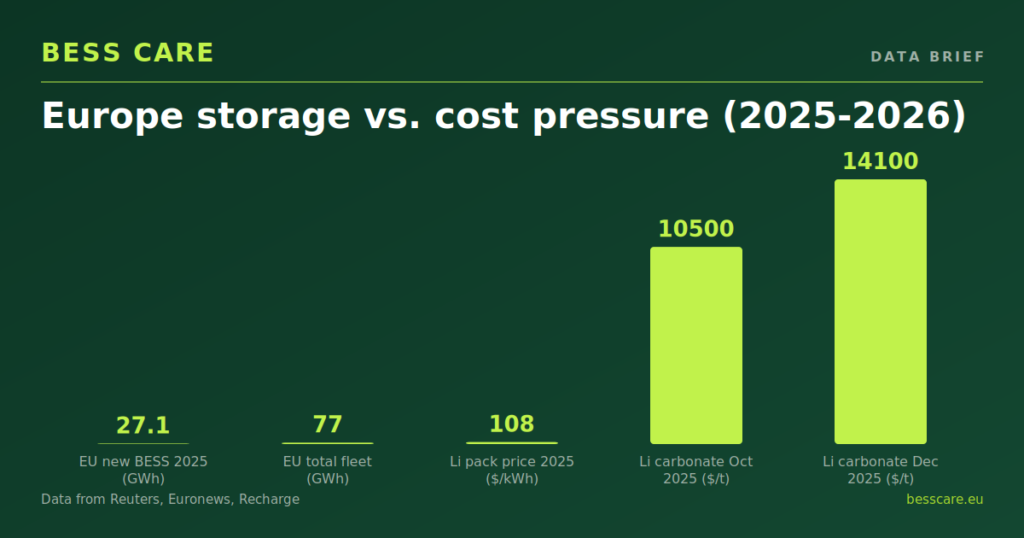
The European Union installed 27.1 GWh of new battery energy storage systems last year, marking 12 consecutive years of record growth, according to a Solar Power Europe report cited by Euronews on July 8, 2026. That same report notes that the EU battery fleet has expanded tenfold since 2021, reaching more than 77 GWh today. The gap between the 77 GWh EU figure and the 100 GW European figure is explained by geography (the EU excludes the UK, Norway, Switzerland, and the Balkans) and by the difference between power (GW) and energy (GWh) ratings. Still, the trend is unambiguous: storage is no longer a niche technology.
But the Solar Power Europe report also cautions that Europe remains “far from where it needs to be.” The tenfold expansion since 2021 is impressive, but it started from a very low base. To meet 2030 climate targets, the deployment rate needs to roughly double again, and that will require solving the cost and supply chain problems that are already emerging.
The most significant risk to the 2026-2027 deployment pipeline is not demand—it is cost. BloombergNEF analyst Isshu Kikuma told Recharge on January 12, 2026, that storage system costs are expected to fall 10-20% in 2026 in the US and Europe. That forecast was made in January, before the full impact of raw material price spikes was clear. The same article notes that lithium-ion pack prices dropped to a record low of $108/kWh in 2025, with stationary storage packs seeing the sharpest declines. That record low is now under threat.
Reuters reported on February 26, 2026, that lithium carbonate prices increased from under $10,500/tonne in mid-October 2025 to over $14,100/tonne by the end of 2025, a 34% increase, according to Nasdaq data. This is not a minor blip; it is a direct reversal of the deflationary trend that made the 2025 boom possible. The same Reuters report states that the Chinese government plans to phase out export tax rebates on battery storage technology by January 2027, which could push up prices for European buyers further. European developers who signed contracts in late 2025 based on $108/kWh pack prices are now facing margin compression or renegotiation pressure.
The Morgan Lewis legal briefing from March 13, 2026, adds a regulatory layer to this cost pressure. The briefing covers AD/CVD investigations, Section 232 actions, and BESS procurement strategies, noting that supply chain scrutiny is intensifying. For European buyers, this means that even if raw material prices stabilize, the cost of compliance, due diligence, and tariff risk allocation will add a premium to every project. The era of assuming that battery costs will only go down is over, at least for the next 12-24 months.
To understand the shift, it helps to compare the key metrics from the 2025 installation boom with the 2026 cost and policy outlook. The table below summarizes the core numbers from the sources.
| Metric | 2025 Actual / Early 2026 | 2026 Outlook / Late 2026 | Source & Date |
|---|---|---|---|
| EU new BESS installations | 27.1 GWh (2025) | Not forecast; growth expected but slower | Euronews, Jul 8, 2026 |
| Total EU battery fleet | 77+ GWh | Growing, but “far from where it needs to be” | Euronews, Jul 8, 2026 |
| Europe total storage capacity | Passed 100 GW (June 2026) | Overtook nuclear in power terms | ESS-News, Jun 22, 2026 |
| Lithium-ion pack price | $108/kWh (2025 record low) | Expected to fall 10-20% (Jan forecast) | Recharge, Jan 12, 2026 |
| Lithium carbonate price | $10,500/tonne (mid-Oct 2025) | $14,100/tonne (end of 2025, +34%) | Reuters, Feb 26, 2026 |
| Chinese export tax rebate | Active | Phase-out by January 2027 | Reuters, Feb 26, 2026 |
| Sodium-ion deployment | Partnership announced | 5 GWh planned across Europe | ESS-News, Jun 22, 2026 |
This table shows a clear divergence. The capacity metrics are all heading in the right direction, but the cost metrics are turning negative. The BloombergNEF forecast of a 10-20% cost decline was made before the lithium carbonate spike and before the Chinese rebate phase-out was fully priced into the market. If those two factors persist, the 2026 cost decline will be smaller than forecast, or may reverse entirely in the second half of the year.
The Euronews report from July 8, 2026, focuses on German homeowners who are turning to battery storage to shield themselves against fossil fuel price shocks. This is the demand side of the story. Germany’s solar-plus-storage adoption is driven by retail electricity prices that remain among the highest in Europe. For a homeowner with a 10 kW solar array, adding a 10-15 kWh battery can cut grid dependence by 60-80%, according to the anecdotal evidence in the Euronews piece. The payback period is now under 8 years in many cases, even without subsidies, because the spread between feed-in tariffs and retail electricity prices is so wide.
But German homeowners are also the most exposed to battery price increases. They buy in smaller volumes than utility-scale developers, so they have less negotiating power. If lithium carbonate prices stay above $14,000/tonne, the retail price of a 10 kWh home battery could rise by 10-15% in late 2026, which would stretch payback periods back toward 10 years. The Euronews report does not quantify this risk, but the Reuters data on raw material prices makes it a logical consequence. The German residential market, which drove much of the 2025 growth, could be the first to slow down if prices rise.
The Morgan Lewis briefing from March 13, 2026, is aimed at utility-scale buyers and their legal counsel. It highlights that procurement strategies in 2026 are no longer just about getting the lowest price per MWh. The focus has shifted to contracting and risk allocation, specifically around supply chain scrutiny, AD/CVD investigations, and Section 232 actions. In practical terms, this means that European utility-scale buyers are now writing contracts that include price adjustment clauses tied to raw material indices, rather than fixed-price agreements. They are also diversifying suppliers away from single-source Chinese cells, even if that means paying a premium, to reduce geopolitical risk.
This is a rational response to the Reuters report’s finding that the Chinese government plans to phase out export tax rebates by January 2027. If that phase-out happens as scheduled, Chinese cells will become more expensive for European buyers, and the cost advantage that Chinese manufacturers have enjoyed over European and US producers will narrow. The Morgan Lewis analysis suggests that sophisticated buyers are already pricing this into their 2027-2028 procurement pipelines. The 2025 boom was built on cheap Chinese cells; the 2026-2027 market will be built on diversified supply chains and more complex contracts.
The Battery Tech Online report from January 13, 2026, notes that BESS adoption in Europe has traditionally been slower than other regions due to higher regulatory requirements. That is changing, but unevenly. The report highlights that many companies are investing in new BESS facilities while government bodies push through new regulations to accelerate adoption. However, the regulatory landscape remains fragmented. The EU Battery Regulation (which covers carbon footprint declarations, recycled content, and due diligence) is being implemented piecemeal across member states. The Morgan Lewis briefing confirms this, noting that EU and UK storage regulation in 2026 covers batteries rules, critical raw materials, net-zero policy, permitting, and UK storage reform, but that these are separate tracks, not a unified framework.
For a homeowner in Germany, this fragmentation means that a battery installed in Bavaria may face different grid connection rules than one installed in North Rhine-Westphalia. For a C&I project owner, it means that a 10 MW project in Spain may require different permitting documentation than a similar project in Italy. The 100 GW milestone was reached despite this fragmentation, which is a testament to the economic fundamentals. But the next 100 GW will be harder to achieve without regulatory harmonization, because the easiest projects have already been built.
For the BessCare audience, the practical takeaways are as follows. First, if you are a homeowner considering a battery in late 2026, do not wait for prices to fall further. The BloombergNEF forecast of a 10-20% decline was made in January, and the raw material data from Reuters suggests that decline may not materialize. Locking in a fixed-price contract now, before the Chinese rebate phase-out takes effect, is a prudent move. Second, if you are a C&I project owner, pay close attention to the risk allocation clauses in your procurement contracts. The Morgan Lewis briefing is clear that fixed-price agreements are becoming rare; you need to understand how price adjustment clauses work and what indices they reference.
Third, consider sodium-ion technology. The Alfen-CATL partnership announced in June 2026 is a signal that sodium-ion is moving from pilot to commercial scale. Sodium-ion batteries are less energy-dense than lithium-ion, but they are cheaper, safer, and less dependent on lithium carbonate prices. For stationary storage applications, where weight and volume are less critical than for EVs, sodium-ion is a credible alternative. The 5 GWh deployment plan is still small compared to the overall market, but it is a hedge against lithium price volatility.
Finally, the 100 GW milestone is real, but it is not a reason for complacency. The Reuters report from February 2026 warns that Europe’s swelling wave of battery installations is set to hit barriers. Those barriers are now visible: raw material costs, trade policy, and regulatory complexity. The market will continue to grow, but the growth will be more expensive and more complicated than it was in 2025. Buyers who plan for that reality will be better positioned than those who assume the good times will last indefinitely.
Energy Storage — https://www.ess-news.com/2026/06/22/europes-storage-capacity-passes-100-gw-overtakes-nuclear (Jun 22, 2026)
Recharge — https://www.rechargenews.com/energy-storage/energy-storage-trends-to-watch-in-2026-analysts/2-1-1922642 (Jan 12, 2026)
Euronews — https://www.euronews.com/2026/07/08/solar-mad-germans-turn-to-battery-storage-to-shield-themselves-against-fossil-fuel-price-s (Jul 8, 2026)
Morgan Lewis — https://www.morganlewis.com/pubs/2026/03/utility-scale-energy-storage-procurements-in-2026-contracting-and-risk-allocation (Mar 13, 2026)
Reuters — https://www.reuters.com/business/energy/europes-swelling-wave-battery-installations-set-hit-barriers–reeii-2026-02-26 (Feb 26, 2026)
Battery Tech Online — https://www.batterytechonline.com/stationary-batteries/europe-s-2025-bess-boom-growth-innovation-and-regulatory-shifts (Jan 13, 2026)