The clearest signal from the latest wave of European EV charging announcements is not about raw power or charging speed. It is about integration. Wallbox, BMW, and Solarwatt are all shipping products that treat the home charger as a component of a home energy management system, not as a standalone device. The key finding: the European home EV charging market has shifted from selling chargers to selling energy ecosystems, and the winners are those who can bundle hardware with software for reimbursement, solar storage, and grid interaction.
Evidence comes from three distinct product launches and deployments between September 2025 and July 2026. Wallbox launched the Pulsar Pro on June 18, 2026, specifically to simplify EV charging reimbursement for fleets and employees. BMW and Solarwatt presented a joint home energy system at Intersolar Europe in June 2026, pairing the Neue Klasse EV with home battery storage. And Wallbox deployed its first Supernova PowerRing fast-charging system at Port de Sitges on the Mediterranean coast on June 3, 2026. Each of these moves points to the same conclusion: the charger is no longer the end product; it is the interface between the car, the home battery, and the electricity market.
Wallbox announced the Pulsar Pro on June 18, 2026, with the launch covered by CleanTechnica on June 19. The product is described as “the latest evolution of its AC charging portfolio designed to simplify EV charging reimbursement.” This is a direct response to a growing operational problem: companies that run EV fleets need to reimburse employees for home charging, but they lack accurate per-session data. The Pulsar Pro addresses this by embedding metering and data reporting into the charger itself, so that a fleet manager can see exactly how many kilowatt-hours were used for a specific vehicle at a specific home.
The significance here is not the hardware specifications, which are typical for a modern AC charger. The significance is that Wallbox is positioning the home charger as a financial instrument. For a homeowner with a company car, the Pulsar Pro turns the home wallbox into a device that produces auditable records. For a home battery owner, the same hardware can be programmed to charge the car only when solar surplus is available, or when electricity prices are low. The Pulsar Pro is therefore not just a charger; it is a data node in a home energy management system.
This launch follows Wallbox’s broader strategy of expanding beyond the home. On September 17, 2025, Wallbox announced the deployment of its eM4 chargers at Munich Airport. The eM4, developed by ABL (part of the Wallbox Group), is designed for semi-public and commercial applications. The Munich Airport deployment shows that Wallbox is pursuing the full spectrum from home AC charging to commercial AC charging to public fast charging. The Supernova PowerRing deployment at Port de Sitges on June 3, 2026, extends this further into high-power public charging.
BMW and Solarwatt presented their joint home energy offering at Intersolar Europe, as reported by Automotive World on June 16, 2026. The partnership is built around the Neue Klasse EV platform, which BMW has designed with bidirectional charging capabilities. The home energy system pairs the Neue Klasse vehicle with a Solarwatt home battery and solar inverter, allowing the car to act as a storage buffer for the home. This is a fundamental shift: the EV is no longer just a load on the home grid; it is a resource that can discharge to power the home during peak hours or during a blackout.
Automotive World’s report quotes BMW’s goal: “Our goal is to help stakeholders understand the future of mobility.” The article notes that “BMW’s push into home energy management signals that the Neue Klasse EV is as much an energy asset as a vehicle.” This is a critical statement for homeowners considering a home battery. If they buy a Neue Klasse BMW, they may not need a separate stationary home battery at all, or they may need a smaller one. The car’s battery can serve the same function, provided the home has the right inverter and charger hardware.
For the home battery market, this is both a threat and an opportunity. It is a threat to the standalone home battery market, because a 70-100 kWh EV battery is far larger than a typical 10-20 kWh home battery. It is an opportunity for companies like Solarwatt that can provide the integration hardware and software. The key takeaway for homeowners: when comparing home battery systems, they must now consider whether their EV charger supports bidirectional flow and whether their car is compatible with it.
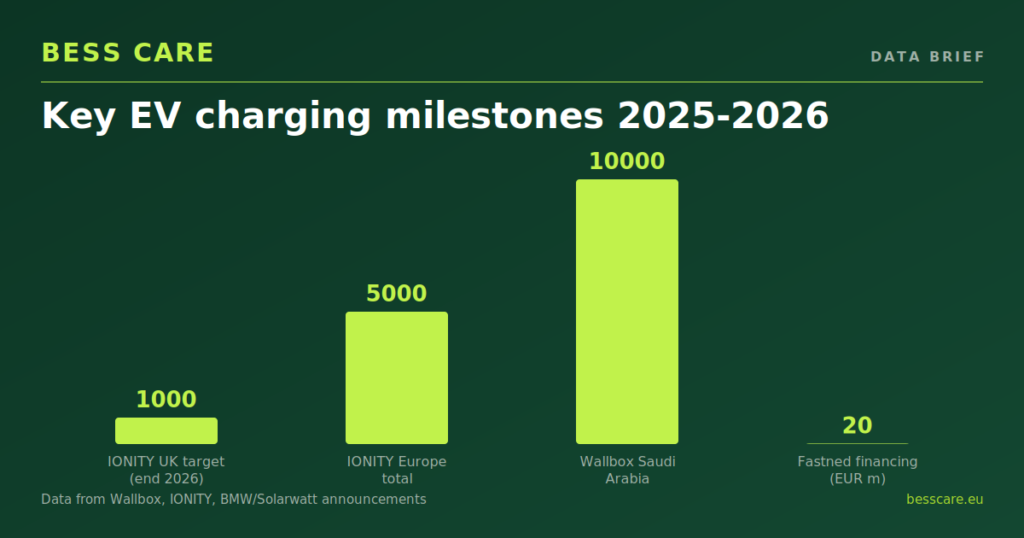
While home charging is becoming more integrated, public ultra-rapid charging continues to scale independently. IONITY posted swift growth of its UK-based ultra-rapid EV charging network, as reported by facilitiesmanagement-now.com on January 26, 2026. The company is aiming to bring its total UK stock to more than 1,000 charging points by the end of 2026. All IONITY charging points in the UK are classed as ultra-rapid. Across Europe, IONITY operates some 5,000 high-power charging points.
This public network growth matters for the home charging story because it changes the economics of battery size. If ultra-rapid public charging is widely available and reliable, homeowners may opt for smaller home batteries and rely on public charging for long trips. Conversely, if home energy management becomes sophisticated enough to earn money from the battery (via peak shaving or grid services), homeowners may want larger batteries. The two trends are complementary, not competing.
The IONITY article also mentions that competing European fast-charging company Fastned has secured up to €20 million in financing. This indicates that the public charging market is attracting significant capital, which will likely drive down the cost of public charging over time. For the homeowner, this means the total cost of ownership of an EV continues to fall, making the home battery investment more attractive as part of a whole-home energy strategy.
On June 3, 2026, Wallbox announced the first real-world deployment of its Supernova PowerRing fast-charging system at Port de Sitges, a high-traffic destination on the Mediterranean coast. The Financial Times announcement (via Business Wire) describes the PowerRing as a fast-charging system, though specific power ratings are not disclosed in the snippet. The deployment at a port is notable because it targets a specific use case: charging for visitors, tourists, and potentially electric boats or marine equipment.
This deployment is relevant to the home market because it demonstrates that Wallbox is building a complete ecosystem. A homeowner who buys a Wallbox Pulsar Pro for home charging can use the same Wallbox app to find and pay for public charging at a Supernova PowerRing. The software integration across home and public charging is a competitive advantage that pure home charger makers do not have. It also normalizes the idea that EV charging is a managed service, not a one-off hardware purchase.
On July 15, 2026, Wallbox and Turning Point Energy announced that they have surpassed 10,000 EV chargers sold and installed across the Kingdom of Saudi Arabia. While this is not a European story, it is relevant to the European market for two reasons. First, it shows that Wallbox has the manufacturing and supply chain capacity to deliver at scale, which matters for European homeowners who want assurance that spare parts and support will be available. Second, it demonstrates that the Wallbox software platform can handle large, distributed fleets of chargers, which is the same software that will manage home chargers in Europe.
The Saudi deployment is also a benchmark for what is possible in a relatively short time. If Wallbox and Turning Point Energy can deploy 10,000 chargers in Saudi Arabia, then European utilities and municipalities can reasonably expect similar or faster deployment rates for home and semi-public charging infrastructure. This is a useful data point for homeowners who are worried about whether the grid can handle widespread EV adoption.
The table below summarizes the key announcements covered in this article, with their dates and core figures.
| Date | Company | Product / Announcement | Key Figure |
|---|---|---|---|
| 2025-09-17 | Wallbox | eM4 chargers at Munich Airport | Deployment at Munich Airport |
| 2026-01-26 | IONITY | UK ultra-rapid network growth | Target of 1,000+ UK points by end of 2026; 5,000 across Europe |
| 2026-06-03 | Wallbox | Supernova PowerRing at Port de Sitges | First real-world deployment in Europe |
| 2026-06-16 | BMW & Solarwatt | Neue Klasse home energy system | Launch at Intersolar Europe |
| 2026-06-18 | Wallbox | Pulsar Pro launch | New AC charger for reimbursement |
| 2026-07-15 | Wallbox & Turning Point Energy | Saudi Arabia deployment milestone | 10,000 chargers sold and installed |
For a homeowner in Europe considering a home battery and an EV charger, the practical implications of these announcements are threefold.
First, the charger you buy today should be capable of bidirectional charging, or at least be upgradeable to it. The BMW/Solarwatt partnership makes it clear that the EV battery will be used as a home battery. If you buy a charger that only supports one-way flow, you will be locked out of this functionality. Wallbox’s Pulsar Pro, with its focus on data and metering, is an example of a charger that is designed to be part of a larger system, not just a dumb cable.
Second, reimbursement and data reporting are becoming standard features, not premium extras. The Pulsar Pro launch signals that even mid-range AC chargers will include metering and reporting capabilities. This is useful not only for fleet drivers but also for homeowners who want to track their energy usage per car, per month, and optimize their solar consumption.
Third, the public charging network is expanding in parallel, which reduces the need for oversized home batteries. IONITY’s target of 1,000 UK points by end of 2026 and its 5,000 points across Europe means that long-distance travel is increasingly feasible without a home battery backup. The home battery can therefore be sized for daily commuting and solar self-consumption, not for range anxiety.
The home battery is no longer a standalone product. It is part of a system that includes the EV, the charger, the solar inverter, and the energy management software. The BMW/Solarwatt launch is the clearest example of this: the Neue Klasse car is the battery, the Solarwatt system is the inverter and controller, and the charger is the connection point. This is a fundamentally different architecture from the traditional model where a home battery sits in the garage and a charger sits on the wall, with no communication between them.
For C&I project owners, the implications are similar but on a larger scale. The Wallbox eM4 deployment at Munich Airport shows that commercial AC charging can be deployed at scale in high-traffic locations. The Supernova PowerRing at Port de Sitges shows that fast charging can be deployed in destination locations. The software that manages these chargers is the same software that manages home chargers, which means that a C&I owner can offer a unified charging experience to employees and customers.
The evidence from the past twelve months is unambiguous. Wallbox, BMW, and Solarwatt are all shipping products that integrate the EV charger with home energy management. The Pulsar Pro adds reimbursement and metering. The BMW/Solarwatt system adds bidirectional flow. The Supernova PowerRing and Munich Airport deployments add public charging to the same software ecosystem. IONITY’s growth adds a reliable public network. The home EV charging market is no longer about the charger; it is about the energy system around it.
Homeowners should therefore evaluate any new charger or battery purchase based on its ability to integrate with other devices, its data reporting capabilities, and its compatibility with bidirectional charging. The days of buying a standalone charger are over. The new standard is a connected, data-rich, bidirectional energy management system, and the companies that deliver this will lead the European market.
Wallbox Deploys Its First Supernova PowerRing Fast-Charging System in Europe — https://markets.ft.com/data/announce/detail?dockey=600-202606030650BIZWIRE_USPRX____20260603_BW579499-1 (Jun 3, 2026)
Wallbox Launches New Pulsar Pro to Simplify EV Charging Reimbursement — https://cleantechnica.com/2026/06/19/wallbox-launches-new-pulsar-pro-to-simplify-ev-charging-reimbursement/ (Jun 19, 2026)
Wallbox & Turning Point Energy Surpass 10,000 EV Chargers Deployed Across Saudi Arabia — https://cleantechnica.com/2026/07/15/wallbox-turning-point-energy-surpass-10000-ev-chargers-deployed-across-saudi-arabia/ (Jul 16, 2026)
BMW and Solarwatt launch Neue Klasse home energy system — https://www.automotiveworld.com/news/bmw-and-solarwatt-launch-neue-klasse-home-energy-system/ (Jun 16, 2026)
Wallbox Strengthens European Presence with New EV Charging Infrastructure at Munich Airport — https://markets.ft.com/data/announce/detail?dockey=600-202509170650BIZWIRE_USPRX____20250917_BW132498-1 (Sep 17, 2025)
IONITY posts swift growth of UK-based ultra-rapid EV charging network — https://www.facilitiesmanagement-now.com/article/249494/ionity-posts-swift-growth-of-ukbased-ultrarapid-ev-charging-network?utm_source=facilitiesmanagement&utm_medium=newsfeed&utm_campaign=facilitiesmanagement-articleId-249494 (Jan 26, 2026)