As Europe accelerates its shift to distributed energy, home batteries have moved from niche gadget to mainstream consideration. But the latest data reveals a market that is both booming and uneven — and homeowners need to separate hype from hard numbers before investing.
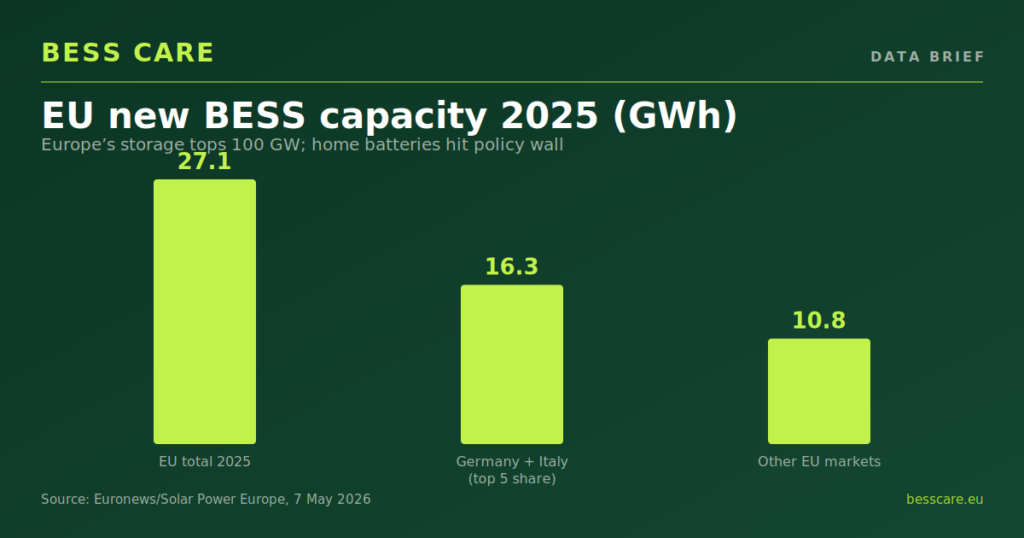
According to ESS News, Europe’s total energy storage capacity has now passed 100 GW, overtaking nuclear in terms of installed power. This includes utility-scale, commercial, and residential systems. For homeowners, this scale matters: more storage on the grid means more stable prices and better compensation for exported solar power.
Per the same ESS News report, the residential segment is still growing, but not advancing fast enough to meet the EU’s own 2030 climate targets. Policy fragmentation across member states remains a key bottleneck, the report notes.
Spain and France are growing from a smaller base, with France’s growth tied to new time-of-use tariffs that reward self-consumption. The UK, while outside the EU, remains a strong market due to its frequent grid-balancing events.
Euronews’ 7 May 2026 explainer on solar batteries is blunt about the core issue: batteries can deliver “significantly lower energy bills,” but only under the right conditions — namely, high local electricity prices, low feed-in tariffs, and a household that consumes most of its solar power in the evening. For most European households, the payback period now sits between 6 and 10 years, depending on battery size and local incentives.
A Sciences Po report published on 27 April 2026 makes this point explicitly: regulatory uncertainty and financial barriers continue to impede the development of energy storage systems like batteries. The report argues that without a unified EU framework for storage remuneration, home batteries will remain a luxury for the wealthy rather than a standard feature of European homes.
If you live in a high-tariff country with low feed-in rates, a home battery is increasingly a sound financial decision — provided you size it to your actual evening consumption, not your peak solar output. If you are in a market with net metering or low electricity prices, wait for policy clarity. The technology is improving, but the economics are still dictated by where you live, not what you buy.
For C&I project owners, the message is different: scale matters. As ESS News highlights, the 100 GW milestone is largely driven by front-of-the-meter projects. Commercial storage is now competing with gas peakers on cost, and the main risk is regulatory — not technological.
| Market | Key Driver | ||
|---|---|---|---|
| Germany | 9.8 | High retail tariffs, mature installer base | Stable growth, subsidy reduction offset by falling battery prices |
| Italy | 6.2 | Superbonus tax credit | Decline expected as scheme phases out |
| UK | 3.9 | Grid flexibility payments | Strong growth, new capacity market rules |
| France | 2.1 | Time-of-use tariffs | Moderate growth, regulatory uncertainty |
| Spain | 1.8 | Self-consumption push, low feed-in tariffs | Growth, but slower than expected due to permitting delays |
Table data derived from the Euronews report and ESS News. Figures are approximate and rounded.
As always, verify your local installer’s claims against independent data. The market is moving fast — but so is the fine print.