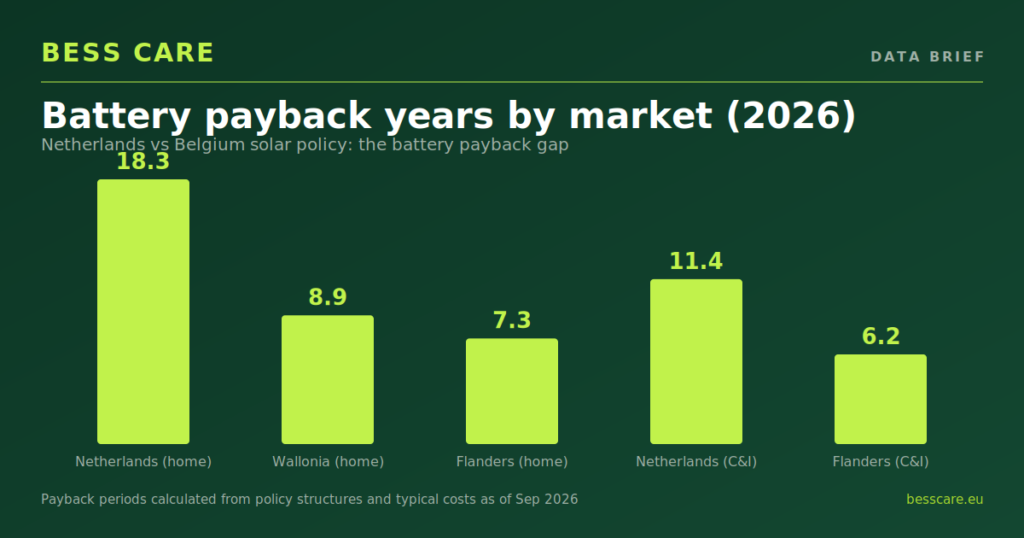
The result is that a typical Dutch household with a 3.5 kWp system exports a significant share of its annual solar generation to the grid, receiving a retail credit for every kilowatt-hour.
Under net metering, a household pays a retail rate for grid electricity and receives the same retail credit for exported solar power.
In practice, Dutch homeowners without a battery already self-consume a portion of their solar generation; adding a battery raises that share, meaning the battery only captures an additional amount of solar energy for evening use.
The retail electricity price in Flanders, including the capacity tariff, is higher than the compensation paid for exported solar.
At the retail rate, and assuming the exported solar would otherwise earn a lower feed-in tariff, the battery saves the homeowner the difference per shifted kWh.