Europe’s home battery market in 2026 is being shaped less by any single national subsidy and more by modular product design, falling pack prices, and a widening gap between countries that have already scaled and those just starting. The result is a market that looks unified in headlines but fragments the moment you look at installation numbers, tariff structures, and grid rules country by country.
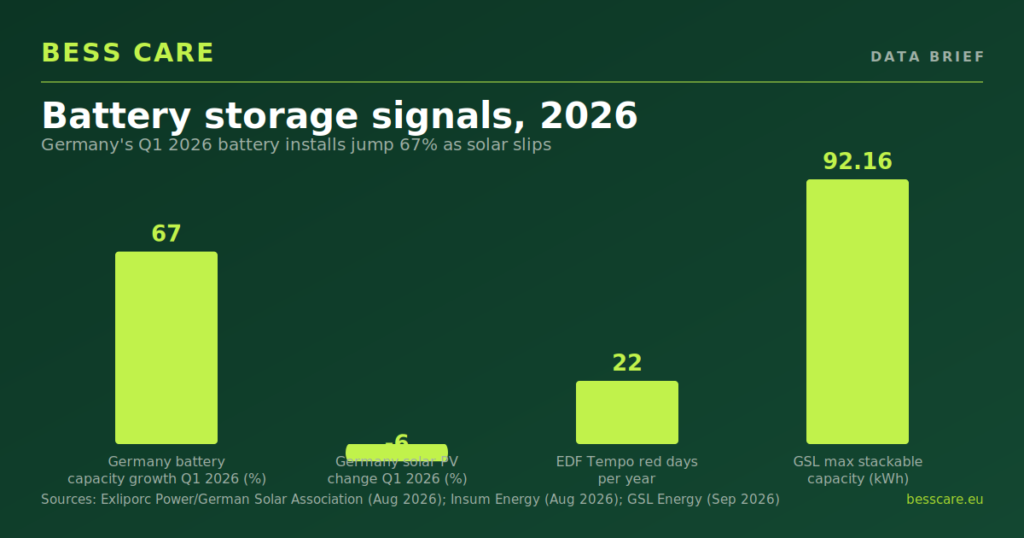
According to CNTE Power, GSL Energy describes a 5.12 kWh LiFePO4 module, 51.2V at 100Ah, with an integrated BMS and fire protection, scalable from 5.12 kWh to 92.16 kWh across wall-mounted, rack-mount and stackable configurations.
According to GSL Energy, battery storage is becoming more valuable across Europe in 2026 on the strength of modular, scalable designs rather than any single national incentive.
Germany remains the volume leader, but the composition of its growth is changing. According to Exliporc Power, Germany’s home battery installations jumped 67% in Q1 2026, a shift driven by retrofits onto existing solar arrays rather than new-build solar-plus-storage packages.
France, Italy, and the UK are moving on different clocks. France’s tariff structure rewards self-consumption more than arbitrage; Italy’s Superbonus legacy still distorts installation counts; the UK is only now normalising battery-ready grid connections at scale.
For homeowners planning a decade-long storage asset, the practical question is whether to expand by adding parallel modules or by swapping to a larger unit. According to Insum Energy, battery swap versus parallel expansion is the central scaling decision for European home storage in 2026, with implications for inverter compatibility, warranty coverage, and resale value.
Europe is not the only market scaling fast. According to The Electric Viking, US battery storage just hit 52 GW and is about to double again by 2028.
According to Market Research Future, Europe, the UK and Asia Pacific energy storage markets are tracked separately in its reporting index, a reminder that “Europe” is not one demand curve.
| Signal | Source | Implication |
|---|---|---|
| CNTE Power / GSL Energy | Modular stackable design is the new baseline | |
| Germany home battery installations +67% in Q1 2026 | Exliporc Power | Retrofit demand is outpacing new-build solar |
| Battery swap vs parallel expansion as key scaling decision | Insum Energy | Upgrade path affects warranty and resale |
| US battery storage at 52 GW, doubling by 2028 | The Electric Viking | Global supply pressure on cells and BMS |
| Europe, UK, Asia Pacific tracked as separate markets | Market Research Future | “Europe” is not one demand curve |
For European homeowners and C&I project owners, 2026 is the year modular design stops being a differentiator and becomes the default. The competitive question shifts from “how big is the battery” to “how cleanly can it scale” — and the answer depends far more on national tariff and grid rules than on any pan-European trend line.