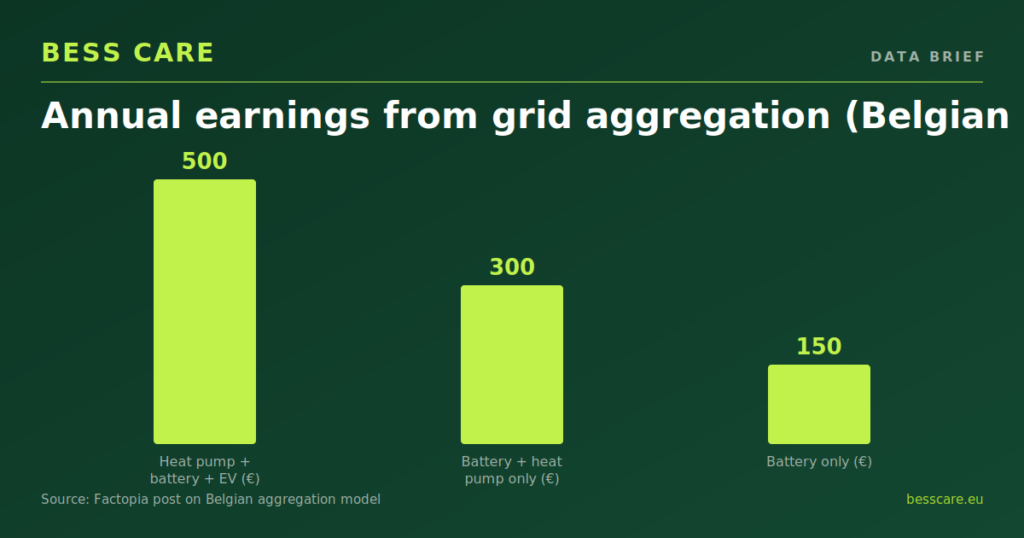
The key finding is straightforward: a Belgian household with a heat pump, a home battery, and an EV charger can earn several hundred euros per year by allowing their energy management system to shift loads — pre-heating the house when electricity is cheap and renewable, charging the car at 3am when wind is generating surplus power, or discharging the battery into the home when the grid needs relief during a cold winter evening peak. This is not a pilot project or a theoretical tariff. It is a live policy outcome in Belgium, where citizens are being turned into grid assets through aggregation of home batteries and heat pumps. For homeowners and C&I project owners across Europe, this marks a decisive shift from static feed-in tariffs to dynamic, grid-service-based revenue streams.
The mechanism is aggregation. Instead of each household negotiating individually with the grid operator, a third-party aggregator pools thousands of home batteries, heat pumps, and EV chargers into a single virtual power plant. When the grid needs relief — typically on cold winter evenings when demand spikes and renewable generation drops — the aggregator signals participating households to discharge their batteries into the home, reducing grid draw. When wind generation is surplus at 3am, the aggregator signals households to charge EVs and pre-heat homes. The household earns money for each kilowatt-hour of flexibility provided. The several hundred euros per year figure is the net annual earning potential for a typical Belgian household with all three devices installed.
This is not a hypothetical scenario. The policy framework in Belgium has evolved to explicitly reward residential flexibility. The grid operator no longer treats home batteries as passive storage; they are active grid assets. The financial incentive is structured to make participation attractive enough to change behavior, but not so generous that it distorts the market. The result is a win-win: households earn money, the grid avoids costly peak capacity investments, and renewable energy is used more efficiently.
For homeowners, the implication is clear: a home battery is no longer just a backup power source or a way to increase self-consumption of solar. It is a revenue-generating asset. The payback period for a battery system shortens significantly when you add several hundred euros per year of grid-service income on top of the savings from avoided grid electricity purchases. For C&I project owners, the aggregation model scales directly. A commercial building with a battery, heat pump, and EV fleet can participate in the same flexibility markets, earning substantially more due to larger capacity.
The Belgian model is particularly relevant because it does not require a separate meter or complex hardware. The household’s existing energy management system handles the load shifting automatically. The aggregator communicates with the system, and the system executes the commands — pre-heating, charging, discharging — without homeowner intervention. This removes the biggest barrier to residential demand response: convenience. Households do not need to monitor prices or manually shift loads. The system does it for them.
To understand the significance, compare the Belgian aggregation model to the traditional solar feed-in tariff model that dominated European policy for the past decade. Under a feed-in tariff, a household with solar panels receives a fixed payment per kilowatt-hour exported to the grid. The rate is set by the regulator and does not vary by time of day or grid conditions. The household has no incentive to shift consumption or discharge a battery strategically. The battery is simply a time-shifting device that increases self-consumption.
Under the Belgian aggregation model, the revenue is dynamic. The household earns more when the grid needs relief most — cold winter evenings — and less when the grid is saturated. This price signal is far more efficient. It rewards exactly the behavior the grid needs, when it needs it. The table below compares the two models across key dimensions.
| Dimension | Traditional Feed-In Tariff | Belgian Aggregation Model |
|---|---|---|
| Revenue basis | Fixed per kWh exported | Dynamic per kWh of flexibility provided |
| Time-of-day variation | None | High — peak evening rates are highest |
| Required hardware | Solar inverter, export meter | Energy management system, battery, heat pump, EV charger |
| Household effort | None | None — fully automated |
| Annual earning potential (typical Belgian household) | Fixed, often declining over time | Several hundred euros per year |
| Grid benefit | Reduces net demand, but not time-shifted | Directly reduces peak demand and absorbs surplus renewable generation |
| Scalability to C&I | Limited by roof space | Scales with battery capacity and flexible loads |
The table makes the structural advantage clear. The feed-in tariff rewards generation regardless of when it occurs. The aggregation model rewards flexibility — the ability to shift load or discharge storage precisely when the grid needs it. This is a fundamental policy shift from paying for energy to paying for grid services.
For a homeowner in Belgium, the process to start earning is well-defined. The first step is to ensure you have the three key devices: a heat pump, a home battery, and an EV charger. If you have all three, you are already a candidate. If you have only a battery and a heat pump, you can still participate, though the earning potential is lower. The second step is to contact an aggregator. The aggregator will assess your system’s compatibility and register it as a flexibility resource. The third step is to sign a contract that specifies how the aggregator will compensate you — typically a fixed annual fee plus a variable payment per kilowatt-hour of flexibility delivered. The fourth step is installation of the communication link between your energy management system and the aggregator’s platform. This is usually done remotely, with no hardware changes required. The fifth step is activation. Once your system is registered and tested, the aggregator will start sending signals, and you will start earning.
The timeline for this process is important. From initial contact to activation, homeowners should expect a period of a few weeks. The aggregator needs to verify your system’s specifications, test the communication link, and run a few trial signals to ensure reliability. After that, the system operates automatically. The aggregator handles all communication with the grid operator, so the homeowner does not need to interact with any utility or regulatory body.
If you are a homeowner considering a new battery or heat pump installation, you should demand specific capabilities from your installer. First, demand an energy management system that is open and compatible with third-party aggregators. Some proprietary systems lock you into a single vendor’s ecosystem, which may not support aggregation. Second, demand a battery that can handle frequent cycling — the aggregation model will discharge and recharge your battery more often than a self-consumption-only setup. Verify the battery’s cycle life and warranty terms. Third, demand a heat pump with a smart thermostat interface that allows external control. Not all heat pumps support this. Fourth, demand an EV charger that can respond to external signals — this is increasingly standard, but confirm it. Fifth, demand that your installer provides a written statement of compatibility with at least one aggregator in your region. If your installer cannot name a specific aggregator, they are not up to date with the market.
For C&I project owners, the demands are similar but scaled. You should demand a battery system with a dedicated energy management controller that can interface with multiple aggregators simultaneously. You should also demand that your system design includes a flexibility assessment — a calculation of how much revenue your battery and flexible loads can earn in the aggregation market. This assessment should be part of the feasibility study, not an afterthought.
From a policy perspective, the timeline for this transition is accelerating. The Belgian model is not a one-off experiment; it is being replicated in other European markets. The key policy change is the recognition of residential flexibility as a grid resource that can be compensated. This requires regulatory changes to allow aggregators to participate in balancing markets and to allow households to receive payments without being classified as energy suppliers. These regulatory changes are happening now across Europe.
For a homeowner, the timeline from decision to first payment is realistic within one to two months. For a C&I project, the timeline is longer — typically three to six months — because the system is larger and requires more coordination with the grid operator. But the revenue potential is proportionally higher.
The Belgian example demonstrates that home batteries are no longer a niche product for energy enthusiasts. They are becoming a standard component of a flexible, grid-interactive home. The several hundred euros per year of additional income is not a game-changer for most households, but it is enough to shorten payback periods and make battery adoption more attractive. More importantly, it creates a new revenue stream that is independent of solar generation. A household with a battery but no solar panels can still earn money by providing flexibility. This decouples battery economics from solar economics, which is a significant market development.
For C&I project owners, the aggregation model offers a way to monetize battery systems that were previously justified only by peak shaving or backup power. The flexibility revenue can be stacked on top of these existing benefits, improving the business case. The key is to design the system with aggregation in mind from the start — choosing compatible hardware and ensuring the energy management system is open and programmable.
No policy is without risks. The primary risk is that the aggregator market is still young, and some aggregators may not be financially stable. Homeowners should choose aggregators with a track record and clear contractual terms. A second risk is that the revenue estimates are based on current market conditions. If the grid becomes less congested or if renewable generation becomes more predictable, the value of flexibility could decline. However, the trend across Europe is toward more variable renewable generation, which increases the value of flexibility. A third risk is that the battery’s cycle life may be reduced by frequent aggregation signals. Homeowners should verify that their battery warranty covers the expected number of cycles. A fourth risk is regulatory change — a future government could alter the rules for aggregation payments. However, the direction of policy is clearly toward rewarding flexibility, not away from it.
The evidence is clear: Belgian households with heat pumps, home batteries, and EV chargers can earn several hundred euros per year by participating in grid aggregation. This is a real, current policy outcome, not a future projection. The model is being replicated across Europe, and the regulatory framework is evolving to support it. For homeowners, the next step is to contact an aggregator and assess your system’s compatibility. For C&I project owners, the next step is to include a flexibility assessment in your next battery or heat pump project. For installers, the next step is to educate yourself on aggregator compatibility and to offer it as a standard feature of your proposals. The era of the passive home battery is over. The era of the grid-interactive home has begun.
Factopia — https://www.facebook.com/Factopia2/posts/belgium-is-turning-its-citizens-into-grid-assets-aggregating-home-batteries-heat/122125693922782858 (date not specified)
Besscare — https://besscare.eu/en/home (Fri, 07 Aug 2026)