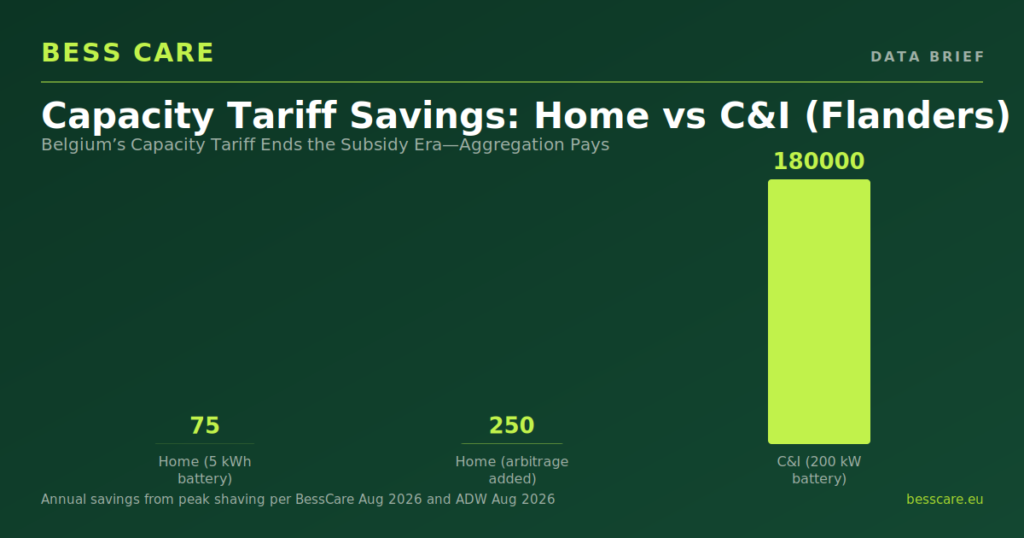
Belgium’s shift to a capacity tariff has changed the economics of home batteries. The tariff charges households based on their peak power draw, measured in 15-minute intervals. This has made peak shaving—using a battery to cover short spikes in demand—a key value driver.
Per Alu-Dewolf’s explainer on the capacity tariff, a typical Flemish household with a 5 kW peak and a 10 kWh battery can shave 1–2 kW off that peak by discharging during the 15-minute measurement window.
Per Peak Energy’s how-it-works page, commercial facilities with demand charges of €80–€120 per kW per month can justify batteries purely on peak shaving.
While peak shaving alone rarely pays back a home battery in Belgium, aggregation—where utilities pay batteries for grid services—can add significant revenue. According to BessCare’s analysis, this changes the payback picture considerably.
| Scenario | Annual Savings (Peak Shaving) | Annual Revenue (Aggregation) | Payback Period |
|---|---|---|---|
| 5 kW / 10 kWh home battery, Flanders | €40–€120 | €150–€300 | 12–18 years |
| Commercial 100 kW / 200 kWh, demand-charge market | €9,600–€14,400 | €3,000–€6,000 | 3–5 years |
For homeowners, the capacity tariff alone rarely justifies a battery. But combined with aggregation programs—as detailed in BessCare’s report—the economics improve. For commercial facilities with high demand charges, batteries can already stand alone on peak shaving alone.