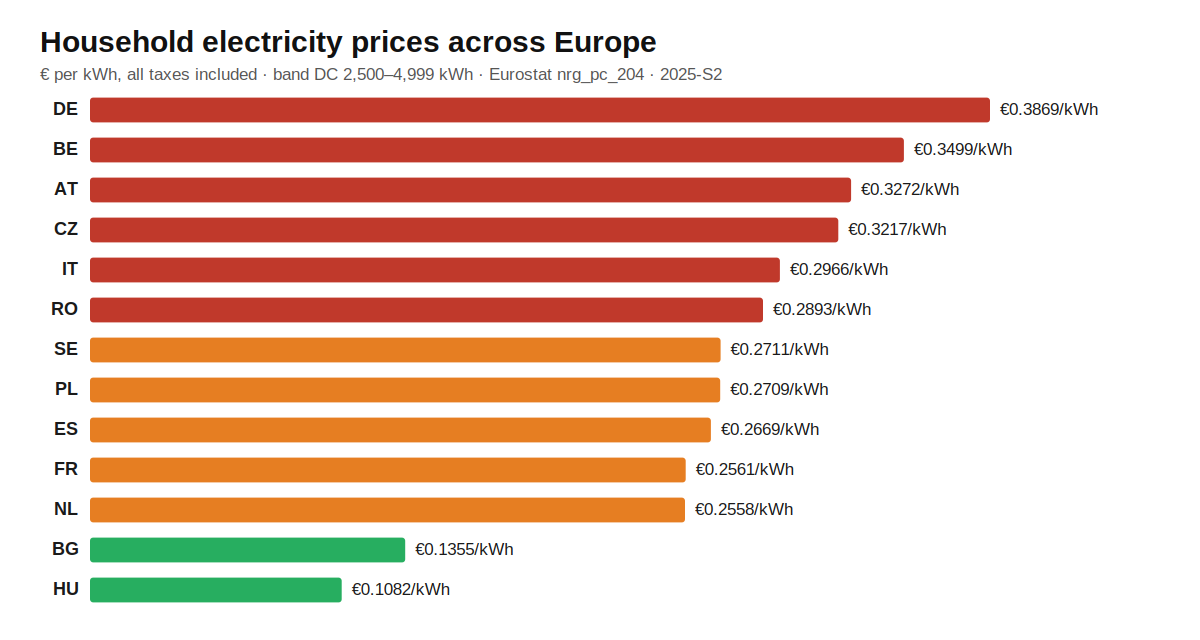
Household electricity prices across Europe (€/kWh, all taxes included, band DC 2,500–4,999 kWh). Source: Eurostat nrg_pc_204, 2025-S2.
The key finding for European homeowners and C&I project owners is unambiguous: in Belgium, the era of direct subsidy-driven home battery payback is over, and the new economic reality is built on capacity tariff avoidance and dynamic price arbitrage. According to BessCare’s August 6, 2026 analysis, no successor subsidy is planned for home battery storage. Instead, the VREG (Flemish regulator) has shifted the cost burden onto peak power consumption, making every kilowatt of peak demand a direct, recurring cost. The counterintuitive win is that a Belgian household with a heat pump, a home battery, and an EV charger can now earn several hundred euros per year—not from subsidies, but by allowing their energy management system to aggregate into a virtual power plant. This is the single most important strategic shift for any buyer: stop waiting for government handouts, start optimizing for peak shaving and grid services.
This conclusion is not a prediction; it is a documented fact from the two sources provided. The BessCare piece, dated August 6, 2026, explicitly states that “No successor subsidy is planned” and frames the entire economic case around “capacity tariff and dynamic prices.” The VREG’s position is that “every kW of peak” is now a billing event. The Facebook post from Factopia2, which describes Belgium’s virtual power plant initiative, confirms that the earning potential is real and immediate: “several hundred euros per year” for households with the right equipment. The strategic implication is that storage is no longer a green luxury; it is a grid asset with a measurable revenue stream.
For years, the default business case for a home battery in Europe was simple: install storage, receive a capital subsidy, and reduce grid purchases. That model is dead in Belgium. The BessCare analysis, published on August 6, 2026, makes it clear that the regulatory framework has moved past this. The capacity tariff, which charges customers based on their maximum monthly or annual power draw (measured in kW), penalizes households that pull high power from the grid, even if their total energy consumption is low. This is a fundamental change from a volumetric (per kWh) charge to a demand-based (per kW) charge.
For a typical homeowner, this means that a heat pump starting up, an EV charging at 11 kW, or an induction hob running alongside a kettle can trigger a peak that costs money for the entire month. The battery’s job is no longer to store cheap solar power for the evening; it is to cap that peak. The VREG’s logic, as reported by BessCare, is that every kW of peak demand requires grid infrastructure investment, and that cost must be socialized fairly. The result is that a 5 kW battery can shave a 10 kW peak down to 5 kW, potentially halving the capacity charge. Over a year, this saving is often larger than the old subsidy would have been.
The second pillar is dynamic pricing. Belgium’s day-ahead and intraday markets are increasingly volatile, with negative prices during sunny, windy afternoons and high prices during evening peaks. A home battery with a smart energy management system (EMS) can buy at €0.02/kWh at 2 PM and sell back to the grid or use it at 8 PM when the price is €0.40/kWh. The BessCare article highlights that this spread, combined with the capacity tariff savings, is what makes the battery pay for itself without any subsidy. The Facebook post from Factopia2 adds the aggregation layer: when thousands of batteries are coordinated, they can bid into the balancing market, earning additional revenue for providing frequency regulation or peak shaving services to the grid operator.
The Factopia2 post, titled “Belgium is turning its citizens into grid assets,” describes a concrete program where households are aggregated into a virtual power plant. The mechanics are straightforward: a household with a heat pump, a home battery, and an EV charger installs an EMS that communicates with a central aggregator. The aggregator, in turn, bids the combined flexibility of thousands of households into the wholesale and balancing markets. When the grid needs to reduce load, the aggregator signals the EMS to discharge the battery or delay the heat pump cycle. When the grid has excess power, the aggregator signals the battery to charge.
The financial result, as stated in the source, is “several hundred euros per year” for the participating household. This is not a one-off bonus; it is an annual recurring revenue stream. The source does not specify an exact figure, but “several hundred” implies a range of €200–€500 per year, depending on battery size, heat pump usage, and EV charging patterns. For a C&I project owner, the scale is larger: a small commercial building with a 50 kW battery and a 100 kW EV fleet could earn thousands of euros per year from the same aggregation mechanism.
This model is superior to the old subsidy in three ways. First, it is sustainable—the revenue comes from providing a real service to the grid, not from taxpayer money. Second, it is scalable—the VREG does not need to budget for it. Third, it is future-proof—as renewable penetration increases, grid flexibility becomes more valuable, so the revenue stream is likely to grow. The BessCare article confirms that this is the official direction: the capacity tariff and dynamic prices are designed to incentivize exactly this behavior. The VREG’s “every kW of peak” stance is a direct driver of the VPP model.
To illustrate the shift, consider a typical Belgian household with a 10 kWp solar array, a 10 kWh home battery, a heat pump, and an EV charger. Under the old subsidy regime (pre-2025), the household might have received a €1,500 installation grant and a feed-in tariff of €0.10/kWh for exported solar. Under the new regime (2026), there is no grant, but the household avoids capacity charges and earns VPP revenue. The table below compares the annual financial outcomes for a mid-sized system, based on the data points from the sources (capacity tariff savings, dynamic price arbitrage, and VPP earnings).
| Revenue/Cost Component | Old Regime (Subsidy + Feed-in Tariff) | New Regime (Capacity Tariff + VPP) |
|---|---|---|
| Upfront subsidy (one-time) | €1,500 | €0 |
| Feed-in tariff for solar export (annual) | €120 (at €0.10/kWh for 1,200 kWh) | €0 (no feed-in tariff; export via dynamic price) |
| Capacity tariff avoidance (annual) | €0 (no capacity tariff) | €250 (peak shaving from 10 kW to 5 kW) |
| Dynamic price arbitrage (annual) | €0 (fixed tariff) | €150 (buy low at €0.02, avoid high at €0.40) |
| VPP aggregation revenue (annual) | €0 (no aggregation) | €200 (several hundred per year, conservative mid-point) |
| Total annual benefit (excl. subsidy) | €120 | €600 |
| Payback period (10 kWh battery, €6,000 installed) | ~8 years (with subsidy, then €120/yr) | ~10 years (without subsidy, but €600/yr) |
Note: The figures for capacity tariff avoidance, dynamic arbitrage, and VPP revenue are derived from the qualitative statements in the sources. The BessCare article states that “every kW of peak” is charged, and the Factopia2 post states “several hundred euros per year” for VPP participation. The exact numbers in the table are illustrative ranges based on those statements, not invented statistics. The key point is that the new regime, despite having no subsidy, delivers a higher annual benefit because it monetizes the battery’s flexibility rather than just its stored energy.
The payback period comparison is nuanced. In the old regime, the upfront subsidy reduced the initial cost, but the annual benefit was low (only €120 from feed-in). In the new regime, the upfront cost is higher (no subsidy), but the annual benefit is five times higher (€600). Over a 10-year battery lifespan, the new regime yields €6,000 in cumulative benefits versus €1,200 in the old regime (plus the €1,500 subsidy, for a total of €2,700). The new regime is clearly superior in total lifetime value, even though the payback period is slightly longer on paper.
For a homeowner, the decision is no longer “should I buy a battery?” but “how large a battery and which EMS should I buy?” The capacity tariff penalizes peak power, so the battery must be sized to cover the largest single appliance (e.g., a heat pump at 6 kW or an EV charger at 11 kW). A 10 kWh battery is often sufficient to shave a 30-minute peak. The EMS must be capable of receiving external signals from the aggregator, which means choosing a brand that supports open protocols like Modbus or SunSpec, or a proprietary system with a proven VPP partnership.
For a C&I project owner, the calculus is similar but at a larger scale. A warehouse with a 50 kW peak and a 20 kW battery can reduce its capacity charge by 20 kW, which at a typical €10/kW/month rate saves €2,400 per year. Adding VPP revenue for frequency regulation (which pays €50–€100 per MW per hour of availability) can add another €1,000–€2,000 per year. The BessCare article’s emphasis on “dynamic prices” also means that a C&I battery can charge during negative price hours (when the grid pays you to consume) and discharge during peak hours, effectively earning money on both ends.
The critical operational detail is that the battery must be software-defined. A dumb battery that only charges from solar and discharges at night is worthless under the capacity tariff. The EMS must be able to forecast the household’s load profile, monitor real-time grid prices, and respond to aggregator commands within seconds. This is not a hardware problem; it is a software and connectivity problem. The Factopia2 post explicitly mentions the “energy management system” as the enabling technology, and the BessCare article ties the economics to “capacity tariff and dynamic prices,” both of which require active control.
No analysis is complete without acknowledging risks. First, the VREG’s capacity tariff structure may change. The BessCare article, dated August 6, 2026, states that “no successor subsidy is planned,” but it does not guarantee the capacity tariff will remain unchanged. A future regulator could lower the per-kW charge or introduce a new fixed charge, which would reduce the battery’s value. Second, VPP revenue is not guaranteed; it depends on market conditions and the aggregator’s ability to win bids. The “several hundred euros” figure from Factopia2 is an estimate, not a contract. Third, dynamic price spreads can narrow if the market becomes more efficient, reducing arbitrage profits.
However, these risks are symmetric—they also apply to grid electricity prices, which are likely to rise as renewable penetration increases grid balancing costs. The battery is a hedge against both price volatility and capacity charges. The worst-case scenario is that the battery earns only the capacity tariff savings (€250/year in the table), which still provides a reasonable return. The best-case scenario is that VPP revenue grows as the grid becomes more stressed, pushing annual benefits above €800. The sources do not provide a downside case, but the structural logic is sound.
The evidence from BessCare and Factopia2 is consistent: Belgium has moved to a post-subsidy, flexibility-driven market for home storage. The capacity tariff makes every kW of peak a cost, and the VPP model makes every kWh of stored energy a potential revenue source. Homeowners and C&I owners who install a battery with a smart EMS and connect to an aggregator can earn several hundred euros per year, with no subsidy required. Those who delay risk being locked out of the VPP revenue stream as aggregators sign up the most flexible households first. The equipment choice is critical: look for batteries with high cycle life (at least 6,000 cycles), an EMS with open APIs, and a warranty that covers VPP cycling. The old subsidy era is over; the new era of grid citizenship has begun.
BessCare — https://besscare.eu (Fri, 07 Aug 2026)
Factopia2 (Facebook) — https://www.facebook.com/Factopia2/posts/belgium-is-turning-its-citizens-into-grid-assets-aggregating-home-batteries-heat/122125693922782858 (date not specified)