The first half of 2026 has already delivered more product launches, utility partnerships, and grid-market integrations than the whole of 2024. For homeowners and C&I project owners, the question is no longer whether to add a battery — it is which battery, and which business model, will still be earning revenue in 2030.
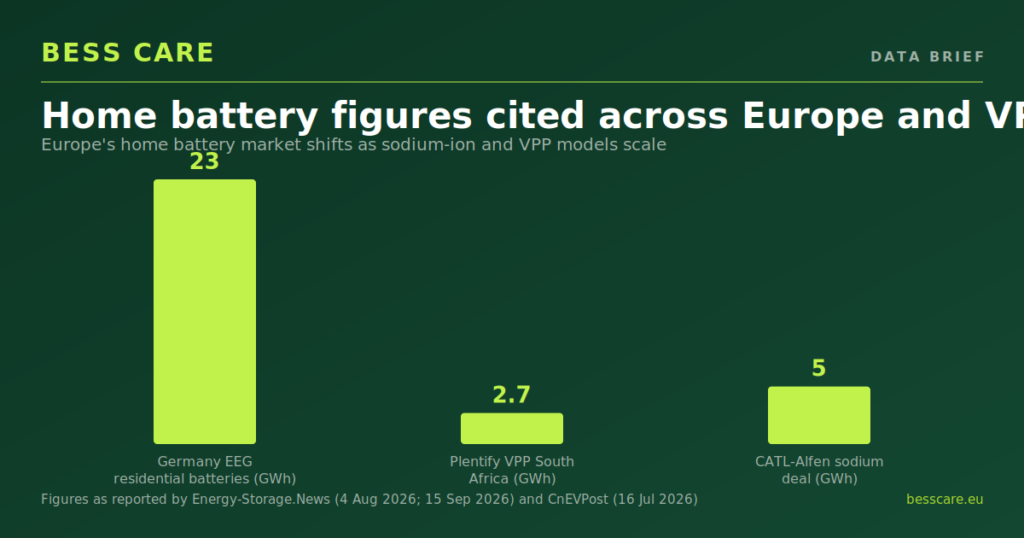
South Africa’s Plentify has aggregated 2.7 GWh of Deye home battery systems into a virtual power plant, according to energy-storage.news — a template that European aggregators are now racing to replicate.
Midea Energy launched integrated home energy solutions for Europe, per TaiyangNews, bundling inverter, battery, and management software into a single consumer-facing package.
CATL’s sodium battery storage push into Europe, tied to a deal with Alfen, was reported by CnEVPost — a signal that sodium-ion is moving from lab curiosity to shipping product.
Unigrid’s sodium-ion home battery debuted in Europe and the US, according to Electrek, offering a chemistry-agnostic alternative to lithium iron phosphate for cost-sensitive installations.
Octopus Energy launched a plug-in home battery, pv magazine reported, targeting renters and apartments that cannot host a wall-mounted system.
| Announcement | Chemistry / Form | Source |
|---|---|---|
| Plentify + Deye VPP | LFP, aggregated | energy-storage.news |
| Midea Energy Europe launch | Integrated home solution | TaiyangNews |
| CATL + Alfen | Sodium-ion | CnEVPost |
| Unigrid debut | Sodium-ion | Electrek |
| Octopus plug-in battery | Plug-in | pv magazine |
| Flexa on German EEG batteries | Grid-scale context | energy-storage.news |
For European homeowners and C&I project owners, 2026 is the year the home battery stopped being a backup appliance and started being a market participant. The winners will be the systems with an aggregation path — and the buyers who ask about that path before they sign the installation contract.