Europe’s residential and commercial solar market is experiencing a paradigm shift. As geopolitical tensions and volatile fossil fuel prices redefine the economics of energy independence, the question is no longer if to install solar, but how much storage to add. For homeowners and C&I project owners, the calculus has changed dramatically over the past 18 months.
Further technical details were reported by PV-Tech, which highlighted that the new ABC (All Back Contact) modules reduce temperature coefficient losses by 15% compared to previous generations, a crucial factor for hot European summers. The launch underscores how manufacturers are racing to deliver higher density and better low-light performance to meet the surging demand.
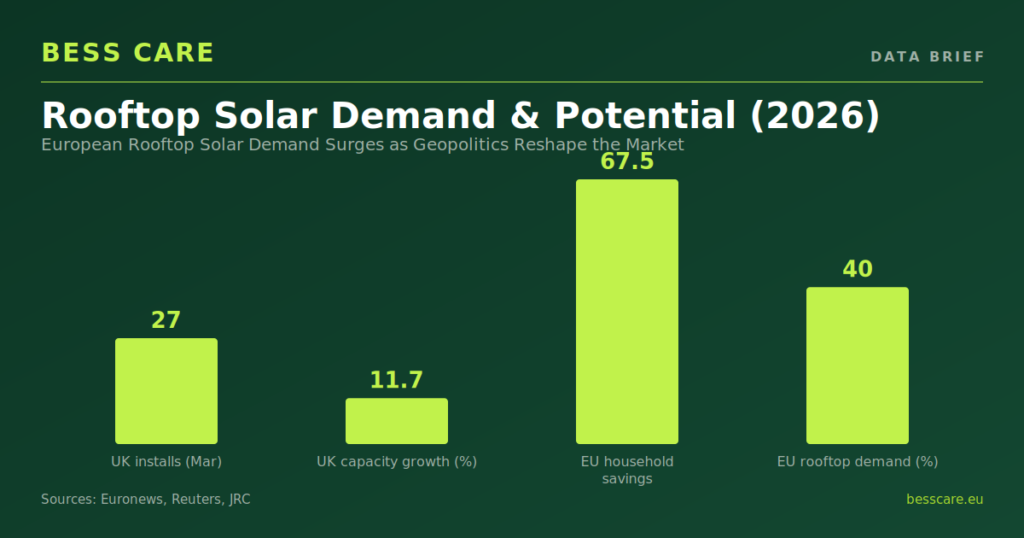
The European Commission’s own January 2026 policy brief reaffirms solar as the “shining star” of Europe’s clean transition, setting a target of 750 GW of installed solar capacity by 2030. Moreover, a Joint Research Centre study published on January 21, 2026, concluded that rooftop solar alone could meet 40% of the EU’s long-term electricity demand, provided that storage deployment scales in parallel.
| Market Segment | Typical Payback (with battery) | Key Driver |
|---|---|---|
| Residential (South EU) | 5-6 years | High retail tariffs, high solar yield |
| Residential (North EU) | 7-8 years | Lower yield, but high electricity prices |
| C&I (Germany, Italy) | 4-5 years | Peak demand charge avoidance |
BessCare editorial note: All figures cited above are sourced from the linked official reports and news analyses. Always verify local incentives and grid fees with your network operator before finalizing your investment decision.