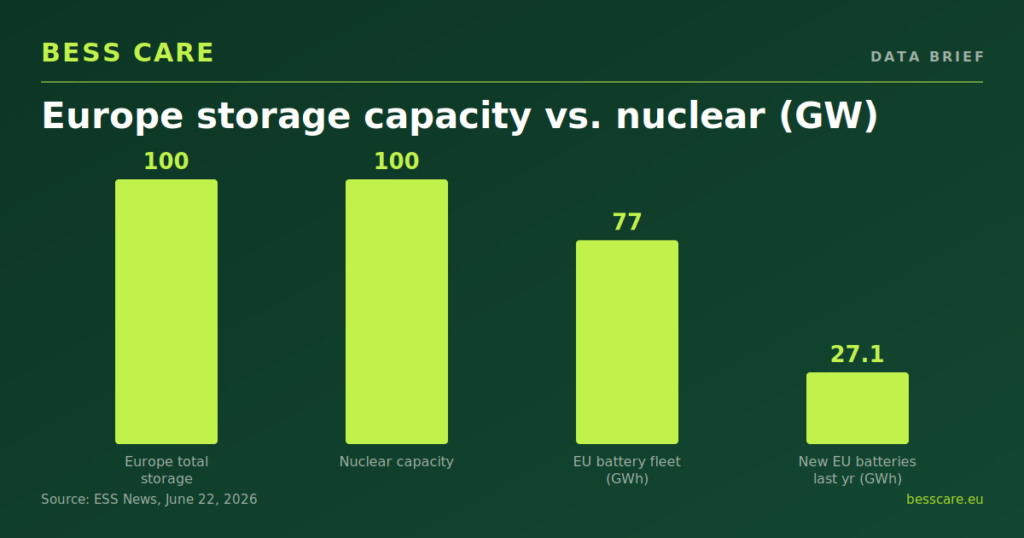
The most significant data point from the past quarter is not a single product launch, but the aggregate figure: Europe’s total energy storage capacity has passed 100 GW, overtaking nuclear generation capacity on the continent, according to a June 22, 2026 report from ESS News. This is a historic inversion. For decades, nuclear baseload was the backbone of European grids; now, dispatchable storage—mostly batteries—has surpassed it in installed power capacity. For homeowners and C&I project owners, this means the grid is becoming more flexible, but also more volatile in price signals, making self-consumption and arbitrage more valuable than ever.
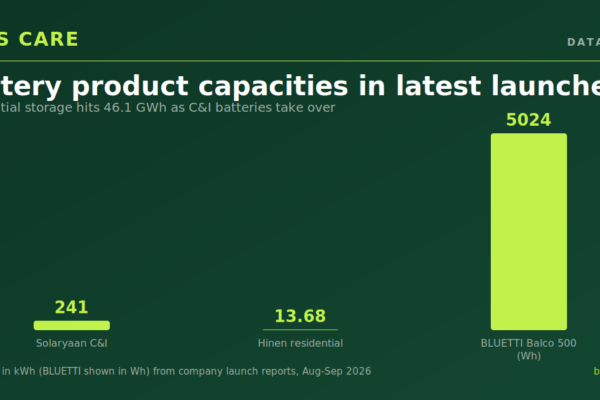
At the residential level, the product landscape is shifting dramatically. The headline from Intersolar Europe 2026 is a balcony solar battery that breaks capacity records: Shenzhen Washi Energy Co., Ltd. (WattCycle) unveiled a 10 kWh, 5 kW unit designed for plug-in balcony solar systems, as reported by TechTimes on June 21, 2026. This is not a niche gadget. A 10 kWh balcony battery is larger than many full-home systems installed just five years ago. The same company also showed a 48V, 628Ah home battery storage unit offering 32.15 kWh of capacity for larger residential photovoltaic installations, targeting homeowners with full rooftop systems rather than balcony users, per the same TechTimes report. The 32.15 kWh figure is notable because it blurs the line between residential and small commercial storage; a single home can now store more than a day’s average consumption for a European household (which typically runs 10-15 kWh/day).
The price trajectory supports this expansion. BloombergNEF energy storage analyst Isshu Kikuma told Recharge in a January 12, 2026 article that storage system costs are expected to fall 10-20% in 2026 in the US and Europe. This follows a record low for lithium-ion pack prices of $108/kWh in 2025, with stationary storage packs seeing the sharpest declines. For a homeowner, a 10 kWh battery at pack level now costs roughly $1,080 in cells alone, before inverters, installation, and margins. At system level, the 10-20% annual cost decline means that the payback period for a typical German home battery is shrinking by several months each year. The Euronews report from July 8, 2026 confirms the demand side: “Solar-mad Germans turn to battery storage to shield themselves against fossil fuel price shocks.” The article notes that last year, the EU installed 27.1 GWh of new battery energy storage systems—marking 12 consecutive years of record growth. According to a 2026 Solar Power Europe report cited by Euronews, despite a tenfold expansion of the EU battery fleet since 2021, reaching more than 77 GWh today, Europe remains “far from where it needs to be.”
But the market is not just about raw capacity. The software and intelligence layer is becoming the differentiator. Hiconics, a major inverter and storage player, discussed its PowerNexus residential smart energy solution at Intersolar Europe, as reported by Energy-Storage.News on July 8, 2026. The key feature is an ROI projection model that uses historical usage patterns and local tariff data to forecast payback periods and lifetime savings. The interface presents all this data through simple charts and colour-coded summaries, making complex analytics immediately understandable for non-technical homeowners. This is a critical shift: the value proposition of a home battery is no longer just backup power, but active financial management. A system that can tell a homeowner “you will save €340/year with this tariff” is far more compelling than a spec sheet.
For C&I project owners, the macro trend is equally important. The ESS News report from June 22, 2026 also details a major partnership: Dutch energy storage provider Alfen and Chinese battery manufacturer CATL plan to deploy 5 GWh of sodium-ion battery energy storage systems across Europe, expanding a partnership that began with lithium-ion technology in 2023. Sodium-ion is significant because it is cheaper and uses more abundant materials than lithium, and it is less prone to thermal runaway. For C&I projects, this could lower the levelized cost of storage further, especially for longer-duration applications. However, the Morgan Lewis legal analysis from March 13, 2026 warns of headwinds: the 2026 outlook on tariffs and trade risk for battery energy storage projects covers supply chain scrutiny, AD/CVD investigations, Section 232 actions, and BESS procurement strategies. In plain terms, the cost declines from technology are being partially offset by trade barriers. A C&I developer sourcing cells from China may face tariffs that eat into the 10-20% cost decline forecast by BloombergNEF. The Morgan Lewis piece also covers EU and UK energy storage regulation in 2026 and beyond, including batteries rules, critical raw materials, net-zero policy, permitting, and UK storage reforms. This regulatory complexity is a double-edged sword: it adds compliance costs but also creates a more stable investment environment.
Let’s put the numbers side by side to understand the scale of change.
| Metric | Value | Source & Date |
|---|---|---|
| EU total battery storage capacity (2026) | 77+ GWh (tenfold expansion since 2021) | Euronews, July 8, 2026 (citing Solar Power Europe) |
| EU new battery installations (last year) | 27.1 GWh | Euronews, July 8, 2026 |
| Europe total storage capacity (all types) | 100+ GW (overtakes nuclear) | ESS News, June 22, 2026 |
| Lithium-ion pack price (2025 record low) | $108/kWh | Recharge, January 12, 2026 (BloombergNEF) |
| Expected system cost decline in 2026 (US & Europe) | 10-20% | Recharge, January 12, 2026 (BloombergNEF) |
| WattCycle balcony battery capacity | 10 kWh / 5 kW | TechTimes, June 21, 2026 |
| WattCycle home battery capacity (48V, 628Ah) | 32.15 kWh | TechTimes, June 21, 2026 |
| Alfen-CATL sodium-ion deployment plan | 5 GWh | ESS News, June 22, 2026 |
The table reveals a paradox. On one hand, the EU fleet is growing at a record pace (27.1 GWh in a single year). On the other hand, the total installed base of 77 GWh is still far below what analysts consider necessary for a renewable-dominant grid. The 100 GW total storage figure includes pumped hydro, which has been around for decades, so the battery-specific number is smaller. But the trend is unmistakable: batteries are the marginal technology, and they are scaling faster than any other storage form.
For the homeowner, the practical implications are threefold. First, the 10 kWh balcony battery from WattCycle signals that the plug-in market is moving from small 800W micro-inverters to serious power levels. A 5 kW output from a balcony unit can power a washing machine, a heat pump circulator, or an EV trickle charge. This is a game-changer for apartment dwellers who cannot install rooftop solar. Second, the 32.15 kWh home unit means that the “whole-home backup” market is now accessible to residential customers, not just C&I. A battery of this size can run a typical European home for two to three days without sun. Third, the Hiconics PowerNexus software layer means that the battery is not just a dumb box; it is a financial asset that optimizes against time-of-use tariffs. The Euronews article emphasizes that Germans are turning to batteries to shield themselves against fossil fuel price shocks—this is a risk-management purchase, not just an environmental one.
For C&I project owners, the Alfen-CATL sodium-ion deal is the most important development. 5 GWh is a massive pipeline, and sodium-ion chemistry is particularly suited for applications where weight and energy density are less critical than cost and safety, such as containerized grid-scale storage. The Morgan Lewis analysis warns that procurement strategies must account for supply chain scrutiny and potential AD/CVD actions. In practice, this means C&I developers should lock in cell supply agreements early, consider dual-sourcing from non-Chinese suppliers (e.g., Korean or European factories), and include tariff escalation clauses in EPC contracts. The 10-20% cost decline forecast by BloombergNEF is an average; a project that gets hit with a 25% tariff on Chinese cells could see costs rise instead of fall. The regulatory outlook in the EU and UK, as covered by Morgan Lewis, includes new batteries rules (due diligence on raw materials), critical raw materials act, and permitting reforms. These are not just compliance burdens; they are also opportunities. Projects that can demonstrate low-carbon supply chains and fast permitting will command premium offtake agreements.
The comparison between the residential and C&I segments is stark. Residential is driven by consumer fear of price spikes and the desire for energy independence. C&I is driven by arbitrage, grid services, and corporate sustainability targets. But both are converging on the same technological platform: lithium-ion (and soon sodium-ion) batteries with smart software. The 10 kWh balcony battery and the 5 GWh sodium-ion pipeline are two ends of the same spectrum. The middle ground—the 32.15 kWh home unit—shows that the spectrum is filling in.
One critical caveat: the 100 GW storage capacity figure from ESS News includes all storage types, not just batteries. Nuclear capacity in Europe is roughly 100 GW, so the overtaking is symbolic but real. However, storage is not a like-for-like replacement for nuclear. A battery can discharge for 2-4 hours, while a nuclear plant runs 24/7. The 100 GW storage figure is dominated by pumped hydro, which has longer duration (6-12 hours). The battery portion is still a fraction of that. So the “overtaking” is about power capacity, not energy delivery. For a homeowner, this means the grid will have more rapid-response capacity, which should reduce the frequency of price spikes, but it does not eliminate the need for home batteries to cover evening peaks when solar fades.
The 27.1 GWh installed last year is a record, but Solar Power Europe’s assessment that Europe is “far from where it needs to be” is a warning. The EU’s REPowerEU plan and the Net-Zero Industry Act call for massive storage deployment to integrate variable renewables. If the EU battery fleet is 77 GWh today, and the need is estimated at 200+ GWh by 2030, then the current growth rate (27 GWh/year) is insufficient. This is where the 10-20% cost decline becomes crucial. Lower costs will unlock demand, especially in Southern Europe where solar is abundant but storage penetration is low. The WattCycle balcony battery at 10 kWh is priced to appeal to the mass market; if system prices fall another 20% in 2026, the payback period for a German household could drop below 5 years, making the purchase a no-brainer for anyone with a balcony or small roof.
In conclusion, the data from the last six months paints a clear picture: storage has crossed the 100 GW mark in Europe, overtaking nuclear in power capacity; residential batteries are scaling up to 10-32 kWh with smart software; and costs are falling 10-20% per year. The Alfen-CATL sodium-ion deal and the Hiconics PowerNexus software show that both chemistry and intelligence are advancing. But trade risks and regulatory complexity, as outlined by Morgan Lewis, could slow the pace. For homeowners and C&I owners, the message is simple: the technology is ready, the economics are improving, and the grid is changing. The only question is whether you will be a participant or a spectator.
TechTimes — https://www.techtimes.com/articles/318771/20260621/balcony-solar-battery-breaks-capacity-records-wattcycle-unveils-10-kwh-5-kw-unit-intersolar.htm (June 21, 2026)
ESS News — https://www.ess-news.com/2026/06/22/europes-storage-capacity-passes-100-gw-overtakes-nuclear (June 22, 2026)
Recharge — https://www.rechargenews.com/energy-storage/energy-storage-trends-to-watch-in-2026-analysts/2-1-1922642 (January 12, 2026)
Energy-Storage.News — https://www.energy-storage.news/hiconics-discusses-powernexus-residential-smart-energy-solution-at-intersolar-europe (July 8, 2026)
Euronews — https://www.euronews.com/2026/07/08/solar-mad-germans-turn-to-battery-storage-to-shield-themselves-against-fossil-fuel-price-s (July 8, 2026)
Morgan Lewis — https://www.morganlewis.com/pubs/2026/03/utility-scale-energy-storage-procurements-in-2026-contracting-and-risk-allocation (March 13, 2026)