The most important finding from the Intersolar Europe 2026 product wave and the latest EU policy moves is not that batteries are getting bigger or cheaper—it is that the European home storage market is bifurcating into two distinct segments: plug-and-play systems for existing solar owners and high-capacity, whole-home energy management systems for new builds and retrofits. The EU’s push to triple storage capacity by 2030 is real, but the industry’s response is not uniform. Companies like MARSTEK are betting on plug-in batteries that require no electrician, while FranklinWH and EP Cube are selling 15kWh-plus systems with smart load control. Both strategies are viable, but they address different pain points, and the data from the first half of 2026 shows why both are needed.
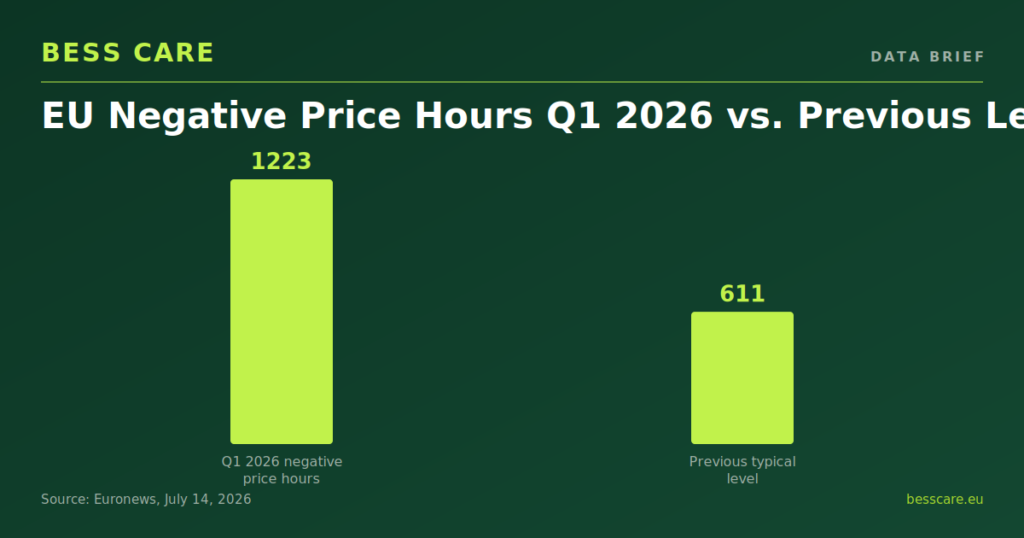
The urgency behind this product surge is quantified in a single statistic: in the first quarter of 2026, EU day-ahead markets recorded 1,223 hours of negative electricity prices, roughly twice previous levels, with Germany and Spain among the hardest hit, according to Euronews (July 14, 2026). That is not a marginal anomaly; it is a structural signal that solar and wind generation routinely exceed grid capacity. The same Euronews report notes that the EU has agreed to scale up storage capacity to triple current levels, a direct response to renewable power going to waste.
This policy target is not just a headline. IndexBox’s analysis (August 8, 2026) frames the debate around blackout fears versus clean energy reality, arguing that the grid flexibility challenge is now the binding constraint on the energy transition. The IndexBox piece points out that without sufficient battery storage, the negative price hours will continue to grow, eroding the business case for new solar installations and creating operational risks for grid operators. The 1,223-hour figure is the single most important number for any homeowner or C&I project owner considering storage in 2026—it means that a battery is no longer a luxury add-on but a financial necessity for anyone exporting solar power during midday hours.
Intersolar Europe 2026, held in Munich in late June, served as the launchpad for the industry’s answer to this policy push. The product announcements fall into two clear categories, and the distinction matters for buyers.
MARSTEK unveiled its new VENUS family at Intersolar Europe 2026 (stand C4.110), expanding its plug-in battery line. The press release (May 31, 2026) describes the VENUS E series as opening “a new era for plug-in batteries.” The key selling point is installation without a certified electrician—a plug-in battery connects directly to a standard wall outlet, using the home’s existing wiring to shift solar power from midday to evening. This is a critical differentiator in markets like Germany and Spain, where electrician shortages and permitting delays can stretch installation timelines by months.
The VENUS family targets the massive installed base of solar-only systems that were installed before storage became economically rational. These homeowners already have PV on the roof; they just need a way to capture the excess. MARSTEK’s approach is to make that upgrade as simple as buying a large appliance. The company’s expansion of the VENUS family suggests that it sees the plug-in segment as the volume driver for the next two years, particularly in rental markets and apartment buildings where permanent battery installation is not feasible.
MOVA LumeGret also presented at Intersolar Europe 2026, debuting the S4800 alongside the A4000 and A2000 systems (GlobeNewswire, June 26, 2026). While MOVA LumeGret’s portfolio is broader than MARSTEK’s, the S4800 debut signals a similar push toward modular, expandable systems that can be installed incrementally. The company’s positioning as a “smart residential energy storage brand” under a global AI smart living leader suggests that software integration—not just hardware capacity—is the competitive battleground.
At the other end of the spectrum, EP Cube presented higher-power single- and three-phase systems, smart-home controls, and EV charging solutions at Intersolar Europe 2026 (Taiyang News, August 19, 2026). This is not a plug-in product; it is a full home energy management platform. The three-phase offering is particularly relevant for European homes with heat pumps or EV chargers, where a single-phase battery cannot handle the load. EP Cube’s integration of EV charging into the storage system is a direct response to the growing number of households that own both an EV and a solar array—the battery becomes the hub that coordinates solar generation, home consumption, and vehicle charging.
FranklinWH also made its European trade show debut at Intersolar Europe 2026, ahead of its planned 2027 entry into the European market (Energy-Storage.News, July 16, 2026). The company’s aPower residential BESS uses lithium iron phosphate (LFP) chemistry, and the aPower2 system has a 15kWh capacity. FranklinWH’s US experience with virtual power plants (VPPs) is the key differentiator—the company has expanded VPP capacity in California and Texas, and it is bringing that grid-interactive capability to Europe. For European homeowners, this means a battery that can not only shift their own solar power but also earn revenue by providing grid services.
| Brand | Product | Capacity | Installation | Key Feature | Source & Date |
|---|---|---|---|---|---|
| MARSTEK | VENUS E | Not specified in source | Plug-in (no electrician) | Plug-and-play for existing solar | PR Newswire, May 31, 2026 |
| MOVA LumeGret | S4800, A4000, A2000 | Not specified in source | Modular | Smart residential storage portfolio | GlobeNewswire, June 26, 2026 |
| EP Cube | Single- and three-phase ESS | Not specified in source | Professional | Smart-home controls, EV charging | Taiyang News, August 19, 2026 |
| FranklinWH | aPower2 | 15kWh | Professional | VPP capability, LFP chemistry | Energy-Storage.News, July 16, 2026 |
The divergence between plug-in and whole-home systems is not a marketing gimmick; it reflects different economic realities. For a homeowner with an existing 5kW solar array and no EV, a plug-in battery like the MARSTEK VENUS E is the fastest way to capture the value of those 1,223 negative-price hours. The payback period is shorter because installation costs are near zero, and the system can be moved if the homeowner relocates. This is the volume segment—it democratizes storage for renters and apartment dwellers who cannot modify their electrical panel.
For a homeowner with a heat pump, an EV, and a larger solar array, the calculus is different. A 15kWh FranklinWH aPower2 or an EP Cube three-phase system can manage the full home load, including EV charging, and can participate in VPP programs that generate ongoing revenue. The IndexBox analysis (August 8, 2026) notes that grid flexibility is becoming a marketable commodity, and FranklinWH’s US experience shows that VPP participation can offset a significant portion of the battery’s upfront cost. The company’s planned 2027 European entry suggests that VPP regulatory frameworks in Europe are not yet mature enough for a full launch, but the direction is clear.
The C&I segment sits between these two camps. Project owners with warehouse rooftops or small commercial buildings need the three-phase capability of EP Cube’s systems, but they also need the software to manage multiple loads. The EP Cube announcement specifically mentions smart-home controls, which in a commercial context translates to load shedding and peak shaving. The company’s expansion of its energy storage portfolio at Intersolar Europe 2026 indicates that it is targeting this middle market aggressively.
FranklinWH’s decision to debut in Europe in 2026 but only enter the market in 2027 is telling. The company is not the only one taking a measured approach. The regulatory landscape for VPPs and grid services varies significantly across EU member states, and the IndexBox analysis highlights that blackout fears are often overstated but the grid flexibility gap is real. The EU’s agreement to triple storage capacity is a top-down target, but implementation is bottom-up—each country must adapt its grid codes, tariff structures, and permitting processes.
For buyers, this means that the best product today may not be the best product in 2027. A plug-in battery is a low-risk entry point that can be supplemented later with a larger system. A whole-home system is a bigger commitment but offers more long-term value if VPP markets develop as expected. The 1,223 negative-price hours in Q1 2026 are a strong argument for acting now, but the choice of system should be based on the home’s specific load profile and the local regulatory environment.
The evidence from the first half of 2026 is unambiguous: the EU’s storage push is not just policy rhetoric, and the product market is responding with a wider range of options than ever before. The 1,223 negative-price hours are a financial signal that storage pays for itself faster than at any point in the last decade. The plug-in segment, led by MARSTEK, lowers the barrier to entry. The whole-home segment, led by EP Cube and FranklinWH, offers maximum flexibility and future VPP revenue. The decision is not which technology is better—it is which fits the specific home or project. The market has split into two speeds, and buyers should pick the lane that matches their timeline, budget, and load requirements.
EP Cube Expands Energy Storage Portfolio — https://taiyangnews.info/technology/ep-cube-expands-energy-storage-portfolio (August 19, 2026)
MARSTEK Unveils the New VENUS Family — https://www.prnewswire.com/news-releases/marstek-unveils-the-new-venus-family-expanding-plug-in-batteries-into-a-new-era-of-home-energy-storage-302786317.html (May 31, 2026)
Sunrun, FranklinWH expand BESS virtual power plant capacity — https://www.energy-storage.news/sunrun-franklinwh-expand-bess-virtual-power-plant-capacity-in-california-texas (July 16, 2026)
MOVA LumeGret Debuts S4800 — https://www.globenewswire.com/news-release/2026/06/26/3318080/0/en/mova-lumegret-debuts-s4800-and-expands-residential-energy-portfolio-at-intersolar-europe-2026.html (June 26, 2026)
EU pushes to triple energy storage — https://www.euronews.com/my-europe/2026/07/14/eu-pushes-to-triple-energy-storage-as-renewable-power-goes-to-waste (July 14, 2026)
EU Battery Storage: Blackout Fears vs. Clean Energy Reality — https://www.indexbox.io/blog/eu-battery-storage-blackout-fears-vs-clean-energy-reality-in-2026 (August 8, 2026)