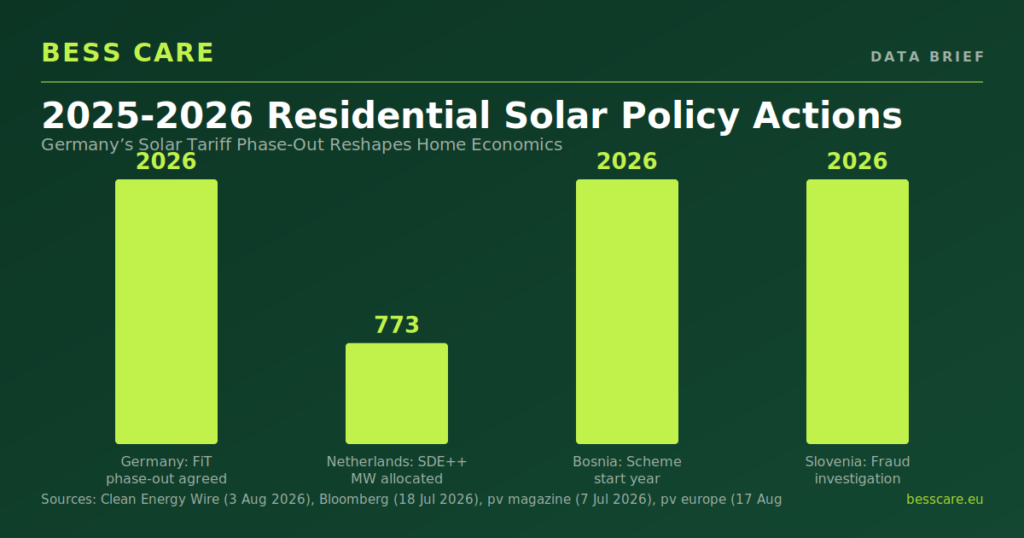
Germany is preparing a major shift in its renewable support framework. According to Clean Energy Wire, from 2027, new small PV generators will be supported based on market and system needs, replacing the fixed feed-in tariff. This move is designed to better align solar generation with grid demand as installed capacity surges.
The Dutch SDE++ subsidy scheme continues to support large-scale solar. Per pv magazine, the 2025 allocation round awarded 773 MW of solar capacity. This outcome reflects the ongoing appetite for ground-mounted projects despite grid congestion challenges in parts of the country.
In a notable step for the Western Balkans, the Federation of Bosnia and Herzegovina has launched its first residential self-consumption subsidy programme. According to pv europe, the programme runs from 2026 to 2030 and is administered by OIEiEK. This initiative is expected to kickstart the residential battery and solar market in the region.
In a separate but relevant development for project developers, the European Public Prosecutor’s Office (EPPO) conducted searches in Slovenia as part of an investigation into suspected solar power plant subsidy fraud. Details are available in the official EPPO press release. This serves as a reminder for C&I project owners to ensure strict compliance with subsidy eligibility criteria.
| Country | Topic | Key Detail | Source |
|---|---|---|---|
| Germany | Fixed feed-in tariff phase-out for new small PV | From 2027, new generators supported based on market/system needs | Clean Energy Wire; Bloomberg |
| Netherlands | SDE++ subsidy scheme | 773 MW of solar allocated in 2025 round | pv magazine |
| Bosnia & Herzegovina (Federation) | First residential self-consumption subsidy | Programme runs 2026-2030, administered by OIEiEK | pv europe |