The most significant shift in European residential solar policy in over two decades is now confirmed: Germany will phase out fixed feed-in tariffs for new small solar PV systems, a move that industry analysts and trade bodies warn could accelerate the decline in residential installations already recorded in the first quarter of 2026. The decision, agreed by the German government in late July 2026, removes the primary financial incentive for homeowners to export surplus power to the grid, forcing a structural pivot toward self-consumption and battery storage. Meanwhile, a countervailing development is taking shape in Southeast Europe, where the Federation of Bosnia and Herzegovina has launched its first-ever residential solar subsidy scheme, signaling that the European market is fragmenting into distinct policy regimes: one of subsidy withdrawal in mature markets and one of state-led adoption in emerging ones.
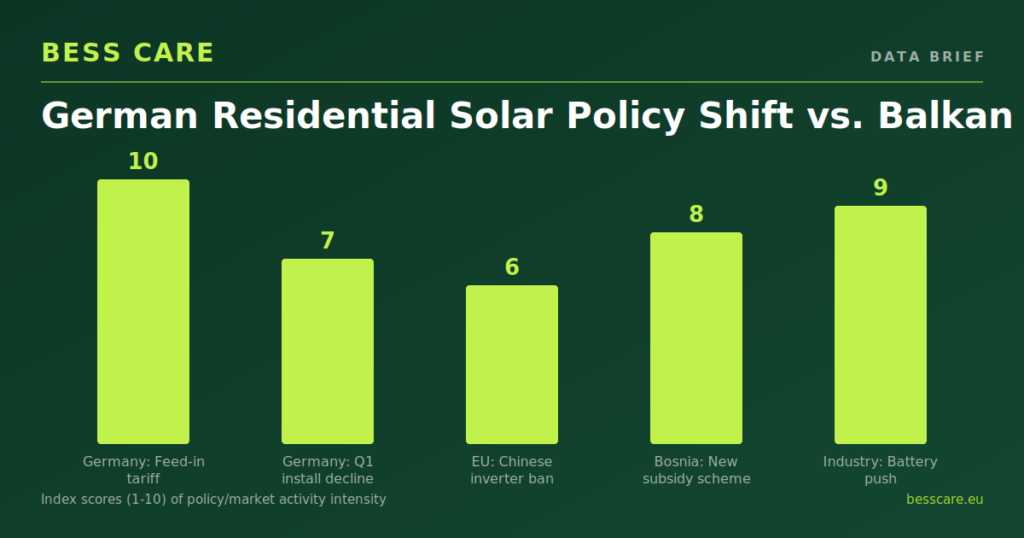
Germany’s landmark Renewable Energy Sources Act (EEG) has been the backbone of European solar deployment for two decades, but the government’s agreement to phase out fixed feed-in tariffs for new small systems up to 25 kW marks a definitive break. According to the Clean Energy Wire report dated July 30, 2026, the government agreed to phase out Germany’s landmark fixed feed-in tariffs for new small solar PV. The draft legislation goes further: it plans to cut any compensation for newly built PV power systems of up to 25 kW – be they residential or commercial – feeding power to the grid from 2027, as detailed in the PV Tech report from May 7, 2026.
The policy rationale is grid stability. Bloomberg’s July 18, 2026 report, “Germany to Slash Renewable Subsidies As Solar Surge Tests Grids,” highlights that the solar surge is testing the country’s distribution networks. The sheer volume of midday solar generation is creating grid congestion, and the government is now prioritizing curtailment and market-based signals over guaranteed payments. This is a direct reversal of the EEG’s original logic, which was to incentivize maximum generation regardless of grid capacity.
The market has already responded to the anticipated policy shift. PV Tech’s May 7, 2026 analysis, “Drop in residential solar drives German PV installations down in Q1 2026,” reports that residential solar installations in Germany fell in the first quarter of 2026, dragging down overall PV installation figures. The trade body BSW-Solar has warned against further subsidy cuts, arguing that the draft EEG plans could drive installations further down. The data suggests that homeowners are delaying or canceling projects in anticipation of the 2027 compensation cut, creating a self-fulfilling prophecy of declining deployment.
This is not a marginal dip. The Q1 2026 figures represent the first major quarterly contraction in the residential segment since the 2022 energy crisis sparked a boom. The combination of high electricity prices, which had made solar economically attractive even without subsidies, is now being offset by the uncertainty over feed-in compensation and the rising cost of capital.
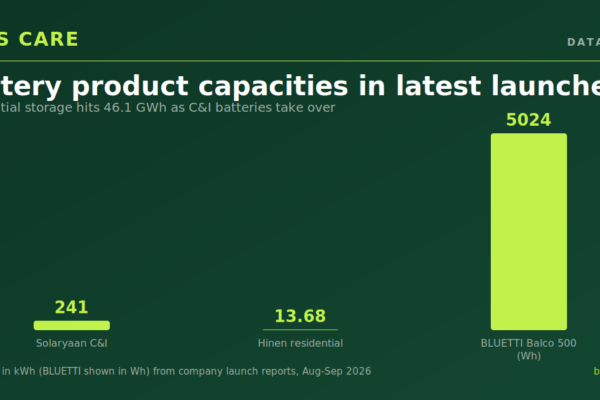
As feed-in tariffs disappear, the economic case for residential solar shifts from selling power to the grid to maximizing self-consumption. This is precisely where battery storage becomes critical. The Intersolar Europe 2026 trade fair, held in Munich in late June, showcased this trend. Energy Storage’s July 2, 2026 report on Fox ESS reveals that the company is betting on bigger home batteries as its commercial and industrial (C&I) push gains ground. Christoph Schön, general manager for the DACH region at Fox ESS, told pv magazine at Intersolar Europe about the company’s residential sizing strategy, which is now oriented toward larger capacity units that can store more of the daytime solar surplus for evening use.
The logic is simple: without a feed-in tariff, every kilowatt-hour exported to the grid is a lost revenue opportunity, and every kilowatt-hour imported from the grid at night is a cost. A larger battery bridges that gap. Fox ESS’s strategy reflects a broader industry consensus that the German market, and by extension the European market, is transitioning from a “solar-only” model to a “solar-plus-storage” model. The company’s C&I push also indicates that the same logic applies to commercial rooftops, where demand charges and peak shaving make batteries even more financially attractive.
| Country/Region | Policy Direction | Key Measure | Market Signal | Source & Date |
|---|---|---|---|---|
| Germany | Subsidy phase-out | No feed-in compensation for new systems ≤25 kW from 2027 | Q1 2026 residential installations down | PV Tech, May 7, 2026; Clean Energy Wire, Jul 30, 2026 |
| Germany | Grid stabilization | Slashing renewable subsidies to manage solar surge | Grid congestion risk; curtailment | Bloomberg, Jul 18, 2026 |
| EU (Brussels) | Supply chain diversification | Development banks not to fund projects using Chinese inverters | Potential impact on ~20% of commercial build-out | Euractiv, Jun 17, 2026 |
| Federation of Bosnia and Herzegovina | New subsidy launch | First residential solar subsidy scheme (2026-2030) | New market entry; self-consumption focus | PV Europe, Aug 17, 2026 |
| Germany (Industry) | Battery adoption | Fox ESS pushes larger home batteries | Shift to self-consumption model | Energy Storage, Jul 2, 2026 |
While Germany is dismantling its domestic subsidy regime, the European Union is erecting new barriers to external competition. The Euractiv report from June 17, 2026, “Europe’s rump solar industry eyes chance as Brussels turns against China,” details how the EU executive has directed the bloc’s development banks not to fund solar power projects using Chinese inverters. Inverters are the ‘brains’ that connect panels to the grid, and this measure could potentially affect a fifth of commercial build-out, according to the report.
This is a significant intervention in the market. While the measure is aimed at preventing the dominance of single suppliers (read: China) in key strategic technologies, it has immediate practical consequences for project developers. If a commercial project relies on EU development bank financing, it must now source inverters from non-Chinese manufacturers, which are typically more expensive and may have longer lead times. This could slow down commercial deployment, even as the residential segment in Germany is already cooling.
The timing is notable. The EU is pushing for “resilience auctions” for onshore wind and large-scale solar according to the EU Net-Zero Industry Act, which would require components to be made in Europe. This is a supply-side intervention designed to rebuild a European manufacturing base that has been decimated by Chinese competition. However, it creates a two-tier market: one for subsidized/financed projects with European content requirements, and another for purely private, unsubsidized projects that can still use cheaper Chinese components.
In stark contrast to Germany, the Federation of Bosnia and Herzegovina is launching its first residential solar subsidy programme. According to PV Europe’s August 17, 2026 report, the programme is designed for private photovoltaic systems focused on self-consumption. Running from 2026 to 2030, the programme has been adopted by the Operator for Renewable Energy and Efficient Cogeneration (OIEiEK), the body responsible for administering the support, and published in the Federation’s official gazette.
This is the first scheme of its kind in the Federation, marking a significant step for a country that has lagged behind the rest of Europe in solar adoption. The focus on self-consumption is notable; it suggests that the Federation is learning from the German experience and designing a scheme that encourages local use of solar power rather than grid export. This avoids the grid congestion problems that Germany is now grappling with. The subsidy will lower the upfront cost of residential PV systems, making them accessible to a broader segment of the population.
The contrast between Germany and Bosnia is instructive. Germany, with its mature market and saturated grid, is moving to a market-based model where solar must compete on its own merits. Bosnia, with its nascent market and lower electricity consumption, is using state subsidies to kickstart adoption. Both policies are rational given their respective contexts, but they point to a divergence in European solar policy that will define the next decade.
For German homeowners, the message is clear: the era of guaranteed feed-in tariffs is ending. The economic calculation for a new PV system must now be based on self-consumption rates, which typically range from 30% to 50% without a battery, and can rise to 70-80% with one. The payback period will lengthen, and the investment case will depend more heavily on electricity price volatility and the cost of battery storage. BSW-Solar’s warning against further subsidy cuts is a plea to protect the residential market from a collapse, but the government appears committed to the phase-out.
For C&I project owners, the EU’s stance on Chinese inverters is a new variable. Projects that rely on EU development bank financing must now factor in the cost and availability of European-made inverters. This could increase project costs by a measurable margin, potentially making some projects unviable. However, it also creates an opportunity for European inverter manufacturers, who have seen their market share eroded by Chinese competitors.
For homeowners in Bosnia and Herzegovina, the new subsidy scheme is a clear incentive to go solar. The programme’s focus on self-consumption means that systems will likely be sized to match household demand, which is a more sustainable model than the oversized systems that were common in Germany during the feed-in tariff boom.
The European residential solar market is undergoing a fundamental restructuring. Germany’s phase-out of feed-in tariffs marks the end of an era, but it is not the end of solar. It is a transition to a more complex, storage-integrated model where the value of solar is determined by its ability to offset grid purchases, not by government-set export rates. The EU’s trade measures add a layer of geopolitical complexity, while Bosnia’s new subsidy scheme shows that the European solar story is not uniform. The next two years will reveal whether the German market can stabilize at a new, lower baseline, and whether the emerging markets in Southeast Europe can fill the gap.