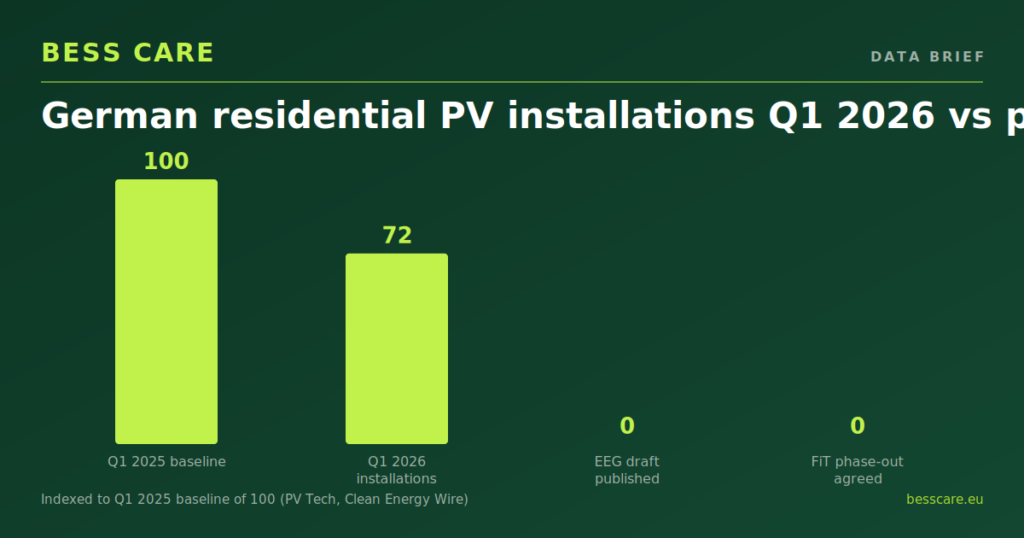
The European residential solar market has entered a phase of policy-driven contraction, and Germany is the clearest example. In Q1 2026, German PV installations dropped sharply, driven almost entirely by a fall in residential demand, according to industry body BSW-Solar. The cause is not a lack of consumer interest but a deliberate policy pivot: the German government has agreed to phase out fixed feed-in tariffs for new small solar PV systems, with a draft of the Renewable Energy Sources Act (EEG) planning to cut all compensation for newly built systems up to 25 kW feeding power to the grid from 2027. This is a structural shift, not a cyclical dip, and it is happening while other European markets—Bosnia and Herzegovina, Tunisia, and even the UK—are opening new subsidy schemes or expanding access to plug-in solar. The result is a fragmented continent where the largest market is actively discouraging new rooftop installations, while smaller markets are building their first support mechanisms.
PV Tech reported on 7 May 2026 that Q1 2026 German PV installations fell, with BSW-Solar attributing the decline specifically to the residential segment. The trade body warned that further subsidy cuts could drive installations even lower. The draft EEG legislation is the core problem: it plans to eliminate any compensation for newly built PV systems up to 25 kW—both residential and commercial—that feed power to the grid, starting in 2027. This is not a marginal tweak; it removes the financial foundation for the typical German homeowner who installs a 5–10 kW system and expects to sell excess generation.
The timeline matters. The government agreed to phase out fixed feed-in tariffs for new small solar PV on 31 July 2026, according to Clean Energy Wire. That agreement came after the Q1 decline was already visible, meaning the market is reacting to anticipated policy, not just enacted law. Homeowners and installers are front-running the change by delaying or cancelling projects. BSW-Solar’s warning is direct: if the draft passes as written, installations will fall further. The trade body is not speculating; it is reading the order book data from its member companies.
This is a reversal of the German model that has defined European residential solar for two decades. The fixed feed-in tariff (FiT) was the landmark policy that made Germany the world’s largest rooftop solar market in the 2010s. Phasing it out for new systems means the market must transition to self-consumption plus battery storage as the primary economic driver. That transition is painful in the short term because battery prices, while falling, still add significant upfront cost. A homeowner who previously saw a 6–8 year payback with FiT income now faces a 10–12 year payback relying solely on avoided grid purchases, unless they install a battery and shift consumption patterns aggressively.
Clean Energy Wire’s 31 July 2026 report details the broader package beyond the FiT phase-out. The government also agreed to cap the permissible level of land lease payments for onshore wind turbines subsidised under the EEG, increase volumes in bioenergy auctions from 2027, create the legal basis for “resilience auctions” for onshore wind and large-scale solar according to the EU Net-Zero Industry Act (including requirements that components be made in Europe), and improve cross-border cooperation on joint renewables projects with neighbouring countries. For residential solar, the key item is unambiguous: no compensation for new systems up to 25 kW from 2027. This is a hard stop, not a gradual reduction.
The irony is that this policy is being implemented at a time when the EU is pushing for more decentralised energy. The Net-Zero Industry Act resilience auctions are designed to secure European manufacturing, but they apply to large-scale projects, not rooftops. Small residential systems are being left to market forces, and the German government is betting that falling hardware costs will compensate for lost feed-in revenue. That bet is not supported by the Q1 2026 data, which shows the opposite: installations fell as soon as the policy direction became clear.
While Germany retreats from subsidies, other European and neighbouring markets are introducing their first residential solar support schemes. This divergence is the key story of 2026. The Federation of Bosnia and Herzegovina launched its first-ever subsidy programme for private photovoltaic systems designed for self-consumption, running from 2026 to 2030. The programme was adopted by the Operator for Renewable Energy and Efficient Cogeneration (OIEiEK) and published in the Federation’s official gazette, according to PV Europe on 17 August 2026. This is a greenfield market: Bosnia had no residential solar subsidy scheme before, so the programme represents a net addition to European rooftop capacity, not a replacement.
In Tunisia, the EBRD, EIB, and EU are supporting a 100 MW solar PV project in the Sidi Bouzid region, with loans of up to €61.3 million to a Scatec-Aeolus joint venture. The EU is providing additional support through EFSD+ guarantees and €5.5 million of grant funding for transmission infrastructure. The plant is expected to generate an average of 252 GWh annually, reducing reliance on natural gas. This is utility-scale, not residential, but it signals that international finance institutions are still willing to back solar in the region, and the EU grant component shows policy support for grid integration. The contrast with Germany is stark: one market is building new transmission infrastructure for solar, another is removing the financial incentive for small generators.
The UK is also moving toward plug-in solar. The BBC reported on 24 March 2026 that the government’s green tech drive includes plans for plug-in panels that homeowners can self-install on balconies, with availability in supermarkets in the coming months. These small panels are already deployed across Europe but are not currently sold in the UK. This is a retail approach to residential solar—treating panels like consumer electronics rather than subsidised infrastructure. It is a different model from Germany’s FiT, but it is an expansion of access, not a contraction.
The Salt Lake Tribune reported on 6 April 2026 that the balcony solar movement is gaining momentum, with Utah as a catalyst. The article profiles Josh Craft, Director of Government Relations and Public Affairs for Utah Clean Energy, showing the outdoor plug that connects his solar panels to his home in Salt Lake City. This is a US example, but the technology is European in origin—plug-in balcony panels are widespread in Germany, Austria, and the Netherlands. The UK’s plan to sell them in supermarkets is a direct import of this European model. The irony is that Germany, the original balcony solar market, is now cutting compensation for small systems, which could slow balcony panel adoption there even as the UK embraces it.
Balcony solar is a different economic proposition from full rooftop systems. A typical balcony panel is 300–600 W, costs €400–€800, and plugs into a standard household outlet. There is no feed-in tariff involved; the value is purely in offsetting daytime consumption. This model is resilient to FiT phase-outs because it never depended on them. Germany’s policy change may actually push more consumers toward balcony panels as a lower-cost entry point, but the draft EEG’s 25 kW cut would also apply to these small systems if they feed power to the grid. The regulation is blunt: it does not distinguish between a 600 W balcony panel and a 10 kW rooftop array.
| Market | Policy status | Key measure | Effective date | Source |
|---|---|---|---|---|
| Germany | Contracting | Phase-out of fixed feed-in tariffs for new small PV (up to 25 kW); no compensation from 2027 | Agreed 31 Jul 2026; draft EEG for 2027 | Clean Energy Wire, 31 Jul 2026; PV Tech, 7 May 2026 |
| Bosnia and Herzegovina (Federation) | Expanding | First residential solar subsidy programme for self-consumption, 2026–2030 | Adopted and published 2026 | PV Europe, 17 Aug 2026 |
| United Kingdom | Expanding | Plug-in balcony solar panels to be sold in supermarkets for self-installation | Announced 24 Mar 2026 | BBC, 24 Mar 2026 |
| Tunisia (utility-scale) | Expanding | 100 MW solar PV plant in Sidi Bouzid; €61.3m loans from EBRD/EIB; €5.5m EU grant | Announced 18 Jun 2026 | EBRD, 18 Jun 2026 |
The practical consequence of the German policy is that new residential solar systems will need to be designed for maximum self-consumption, not maximum export. This changes the optimal system size. Under the FiT regime, homeowners often oversized their arrays to maximise feed-in revenue. Without compensation, the optimal size is smaller—just enough to cover daytime baseload—unless paired with a battery. The economics of battery storage become more favourable because the battery allows the homeowner to shift solar generation to evening hours, when grid electricity is most expensive. However, battery costs remain a barrier. The Q1 2026 installation decline suggests that homeowners are not yet convinced that the battery-plus-self-consumption model is worth the upfront investment.
Installers are also affected. The residential solar installation business in Germany has been built on a steady stream of FiT-backed projects. A sudden policy shift creates a boom-bust cycle: a rush to install before the 2027 deadline, followed by a cliff. BSW-Solar’s warning is aimed at preventing that cliff. The trade body is not asking for the FiT to be maintained forever; it is asking for a predictable transition. The draft EEG does not provide that predictability—it is a hard cut-off with no grandfathering for systems that are in the pipeline.
Comparing Germany’s contraction with Bosnia’s expansion and the UK’s retail approach reveals a continent without a unified residential solar strategy. The EU’s Net-Zero Industry Act focuses on manufacturing resilience and large-scale auctions, not on small rooftop systems. National governments are left to set their own residential policies, and they are diverging sharply. Germany is removing subsidies; Bosnia is introducing them; the UK is treating solar as a consumer product; Tunisia is building utility-scale with international finance. This fragmentation makes it difficult for European solar manufacturers to plan, because demand signals from the residential segment are contradictory.
The data from Q1 2026 is a warning, not a blip. Germany is the largest residential solar market in Europe, and its decline will pull down the European total. BSW-Solar’s statement is unambiguous: further subsidy cuts could drive installations further down. The draft EEG’s 25 kW cut is exactly that kind of cut. If it passes, the European residential solar market will shrink in 2027, even as Bosnia and the UK add new capacity. The net effect is likely negative for the continent as a whole, because Germany’s volume dwarfs the new entrants.
PV Tech — https://www.pv-tech.org/drop-in-residential-solar-drives-german-pv-installations-down-in-q1-2026 (7 May 2026)
PV Europe — https://www.pveurope.eu/markets/bosnia-and-herzegovina-opens-first-residential-solar-scheme (17 Aug 2026)
Clean Energy Wire — https://www.cleanenergywire.org/news/government-agrees-phase-out-germanys-landmark-fixed-feed-tariffs-new-small-solar-pv (31 Jul 2026)
BBC — https://www.bbc.com/news/articles/czjw7klkjm2o (24 Mar 2026)
EBRD — https://www.ebrd.com/home/news-and-events/news/2026/ebrd–eib-and-eu-support-tunisia-s-energy-transition-and-resilie.html (18 Jun 2026)
The Salt Lake Tribune — https://www.sltrib.com/news/environment/2026/04/06/balcony-solar-movement-gains (6 Apr 2026)