The key finding from the latest wave of product launches and financial guidance is that the European home EV charging market has shifted decisively from a race for kilowatt bragging rights to a battle over software integration, reimbursement accuracy, and grid flexibility. Wallbox’s new Pulsar Pro, launched on 19 June 2026, is the clearest signal yet: the company is betting that the winning feature set is not a higher charging rate but the ability to track costs per driver, comply with AFIR, and integrate with solar storage. This conclusion is supported by the company’s own financial outlook, which shows a disciplined revenue target of €33–36 million for Q1 2026, and by parallel moves from SunEnergyXT and ChargePoint, all pointing to a market where the charger is becoming a smart home energy device rather than a simple cable.
The most concrete evidence of this shift comes from CleanTechnica’s report on the Pulsar Pro, published 19 June 2026. The device is not positioned as the fastest or most powerful charger on the market. Instead, Wallbox is highlighting its reimbursement features, which allow fleet managers and homeowners to track exactly how much energy each vehicle consumes. This is a direct response to a growing pain point: as more households and small businesses install multiple EVs, the question of “who pays for what” becomes a logistical headache. The Pulsar Pro solves this with per-user access controls and remote management, making it possible to bill a tenant, an employee, or a family member accurately.
The timing is also strategic. The product is available across the European Union now, with a UK and North American launch slated for 2027. This staggered rollout suggests Wallbox is prioritizing markets where AFIR (the EU’s Alternative Fuels Infrastructure Regulation) is already driving demand for smart, data-capable chargers. AFIR compliance is not just a checkbox; it requires chargers to support dynamic load balancing and remote monitoring, both of which the Pulsar Pro includes. In other words, Wallbox is not selling a charger; it is selling a compliance and accounting tool that happens to deliver electricity.
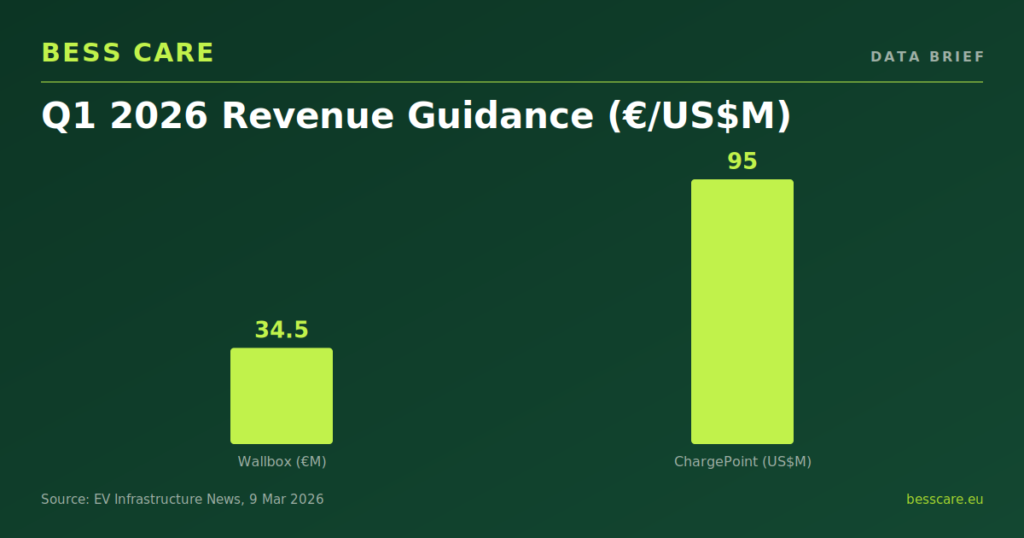
The financial context for this strategy is provided by EV Infrastructure News, which reported on 9 March 2026 that EV charging companies are “weathering the storm” with steady results. Wallbox’s own guidance for Q1 2026 is €33 million to €36 million in revenue, which translates to roughly US$34.7 million to US$37.8 million. ChargePoint, its main US competitor, is guiding for $90 million to $100 million in the same period. These numbers are not explosive growth figures; they are the numbers of a mature, consolidating industry. The fact that Wallbox is guiding for a narrow range suggests management has a clear line of sight into its order book, likely driven by the Pulsar Pro’s pre-orders and the Freenow partnership.
This financial discipline matters because it changes the competitive dynamic. A company that is not chasing hypergrowth can afford to invest in software features like reimbursement tracking, which have lower upfront costs but higher long-term stickiness. ChargePoint’s larger revenue base, by contrast, reflects its broader portfolio across commercial and fleet charging, but it also exposes the company to more volatile segments. For the homeowner, this means the choice of charger is increasingly a choice of software ecosystem: Wallbox is betting that its app and cloud services will be the reason you stay, not the hardware on your wall.
While Wallbox is focused on reimbursement, the broader market is still waiting for bidirectional charging to go mainstream. Zecar’s comprehensive guide, updated 11 April 2026, outlines the state of V2H (Vehicle-to-Home) and V2G (Vehicle-to-Grid) technology. The guide highlights the Wallbox Quasar 2 as a trailblazer, but it also notes that the ecosystem is still fragmented. For a European homeowner, the promise of using an EV battery to power a house during an outage or to sell energy back to the grid is compelling, but the practical hurdles remain: not all EVs support bidirectional discharge, and not all utility markets have the tariff structures to make V2G financially attractive.
The Zecar guide, while focused on Australia, is relevant to Europe because it underscores a universal truth: bidirectional charging is a hardware-plus-software problem. The charger must communicate with the car, the home battery, and the grid operator simultaneously. This is where the convergence with home solar storage becomes critical. A charger that can only talk to the car is a dead end; a charger that can coordinate with a battery inverter and a smart meter is the future. Wallbox’s Pulsar Pro, with its solar charging integration, is a step in this direction, but it is not yet a full V2G solution. That gap is the next battleground.
The convergence of charging and storage is also visible in SunEnergyXT’s product expansion, reported by Notebookcheck on 18 June 2026. The company, formerly known as SunLit Solar, is adding three products ahead of ees Europe 2026: the PowerBox, the 500 Pro AC Core, and a new smart charger. The PowerBox is an 11 kW wallbox, which is a standard power level for home charging, but the key is its integration with the 500 Pro Series storage system. This is not just a charger; it is the third leg of a home energy stool that includes solar panels, a battery, and now an EV charger that can intelligently route power between all three.
The significance here is that SunEnergyXT is not trying to out-muscle Wallbox or ChargePoint on features. Instead, it is offering a vertically integrated solution for homeowners who want a single brand for their entire energy system. This is a different competitive strategy, but it speaks to the same underlying trend: the charger is becoming a component of a larger energy management system. For the consumer, this means the decision is no longer “which charger do I buy?” but “which energy ecosystem do I join?” The 11 kW power level is sufficient for overnight charging for the vast majority of drivers, so the differentiation is in the software and the integration, not the raw amperage.
Wallbox’s partnership with Freenow by Lyft, reported by Automotive World on 13 May 2026, provides a real-world laboratory for the Pulsar Pro’s reimbursement features. The deal covers Germany, France, the UK, Ireland, and Spain, and it is aimed at taxi drivers and fleet operators. This is a smart move for two reasons. First, taxi drivers are high-mileage, high-utilization users who need reliable, fast charging and clear cost tracking. Second, fleets are the segment most likely to adopt multi-user charging infrastructure, where the reimbursement feature becomes essential.
The partnership also gives Wallbox a data advantage. By deploying chargers across multiple European markets with a single platform, Wallbox can gather real-world usage data on charging patterns, grid constraints, and driver behavior. This data can then be fed back into product development, making the Pulsar Pro and its successors more attuned to actual market needs. For the homeowner, this is a reassuring sign: the technology in your garage is being stress-tested by professional drivers who cannot afford downtime.
Car and Driver’s testing of home EV chargers, published 29 April 2026, offers a grounded perspective on the hardware itself. The review notes that the Wallbox unit is “lighter and smaller than most—roughly an eight-by-eight-inch square—so it doesn’t take up much wall real estate.” This is a practical consideration that often gets overlooked in spec-sheet comparisons. The app, according to the review, has a “clean look” and is “easy to use,” with the ability to schedule charge times based on variable electricity rates. However, the review also flags a limitation: the pricing function “lacks the ability to track a variable rate like” some competitors. This is a minor but telling gap, especially in markets like Spain or Italy where time-of-use tariffs are common.
This assessment reinforces the conclusion that the market is not yet perfect. While Wallbox is leading on reimbursement and fleet management, it still has room to improve on consumer-facing rate tracking. The good news is that this is a software update away, not a hardware redesign. The physical product is solid, the app is usable, and the integration with solar is a differentiator. For a homeowner, the Car and Driver review suggests that the Wallbox is a safe, reliable choice, but not necessarily the absolute best for every use case.
To make sense of the competitive landscape, the table below summarizes the key data points from the sources as of mid-2026. It is not an exhaustive comparison, but it captures the strategic differences that matter most to a homeowner or a small fleet operator.
| Company / Product | Key Feature | Financial / Market Signal | Source & Date |
|---|---|---|---|
| Wallbox Pulsar Pro | Reimbursement tracking, AFIR compliance, solar integration | Q1 2026 revenue guidance: €33–36 million | CleanTechnica, 19 Jun 2026; EV Infra News, 9 Mar 2026 |
| ChargePoint | Broad portfolio across home, commercial, fleet | Q1 2026 revenue guidance: $90–100 million | EV Infra News, 9 Mar 2026 |
| Wallbox Quasar 2 | Bidirectional V2H/V2G capability | Trailblazer in bidirectional segment | Zecar, 11 Apr 2026 |
| SunEnergyXT PowerBox | 11 kW wallbox integrated with 500 Pro storage | New product launch ahead of ees Europe 2026 | Notebookcheck, 18 Jun 2026 |
| Wallbox (general) | Compact design, easy-to-use app | Tested by Car and Driver; noted rate-tracking gap | Car and Driver, 29 Apr 2026 |
| Wallbox + Freenow | Fleet charging for taxis | Launched in DE, FR, UK, IE, ES | Automotive World, 13 May 2026 |
For a homeowner, the practical takeaway is that the era of buying a charger based on maximum amperage is over. An 11 kW or 22 kW unit will charge almost any EV overnight. The real differentiators are now software features: Can the charger track costs per user? Can it integrate with your solar panels and battery? Can it comply with future EU regulations? The Pulsar Pro answers yes to all three, which is why it is the current benchmark.
For a small commercial or industrial (C&I) owner, the Freenow partnership is the template. If you run a small fleet, even just five or ten vehicles, the ability to allocate charging costs to specific drivers or jobs is not a luxury; it is an accounting necessity. The Pulsar Pro’s remote management and user access controls turn a capital expense into an operational tool. The SunEnergyXT approach, meanwhile, is attractive if you are building a new facility and want a single vendor for solar, storage, and charging.
The financial guidance from Wallbox and ChargePoint also matters for buyers. A company that is guiding for steady, predictable revenue is more likely to be around in five years to support its software and honor its warranty. A company chasing hypergrowth might cut corners or pivot away from the home market. The steady numbers from Wallbox and ChargePoint are a positive signal for long-term reliability.
Looking forward, the next 12 to 18 months will be defined by three forces. First, AFIR compliance will become mandatory for new chargers in the EU, which will push all manufacturers to include at least basic smart features. This will raise the floor for everyone, making the Pulsar Pro’s advanced features less of a differentiator and more of a baseline. Second, bidirectional charging will slowly move from pilot projects to commercial products, but only if the grid operators and utilities create the right tariff structures. The Zecar guide is clear that the technology works, but the business case is still shaky in most markets.
Third, the integration of home solar, storage, and EV charging will become the default for new installations. SunEnergyXT’s move is an early example, but expect Wallbox, ChargePoint, and others to follow with their own integrated offerings. The winner will be the company that makes the user experience seamless: one app, one bill, one interface for your entire home energy system. The Pulsar Pro is a strong contender, but the race is far from over.
In summary, the data from the sources paints a clear picture: the home EV charging market in Europe is maturing. The winners will be those who master software, compliance, and integration, not those who simply offer the highest amperage. Wallbox is currently leading this charge, but the market is dynamic, and the next 12 months will be decisive.