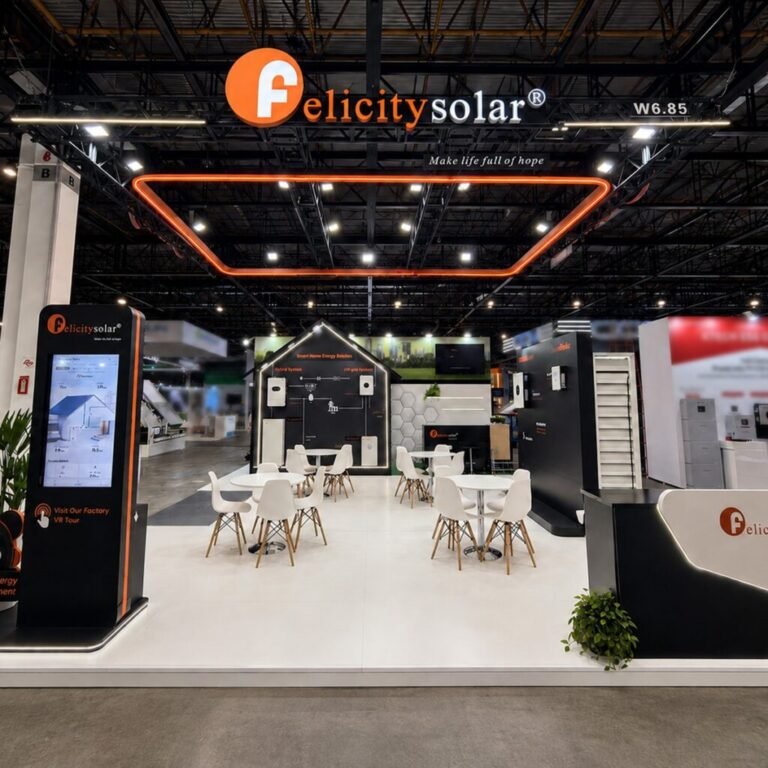
The clearest signal from Intersolar Europe 2026 in Munich was not a single breakthrough cell chemistry but a structural bet: residential storage makers are pushing battery capacity up to the 30-plus-kWh range while simultaneously racing into plug-and-play balcony solar storage.
WattCycle used the show to launch a 48V 628Ah LiFePO4 home battery rated at 32.15 kWh, alongside an all-in-one balcony storage system with up to 10 kWh of capacity and 2.5 kW and 5 kW bidirectional power options, according to a company release carried by Yahoo Finance (June 20, 2026).
Humsienk, another exhibitor, presented the same 48V 628Ah / 32.15 kWh whole-home battery format at Booth C2.375, paired with an AC-coupled balcony battery whose rated capacity is 7,680 Wh (150 Ah at 51.2 V) and a 10-millisecond UPS switchover, per the company’s own Intersolar blog post.
Anker SOLIX showed its Solarbank 4 E5000 Pro modular balcony storage, which expands to 30 kWh and reaches availability in July 2026, according to TaiyangNews’ live coverage of the show.
The appearance of multiple 32 kWh-class products is not a coincidence. A 30-plus-kWh system can cover a full evening’s household load plus overnight appliances, moving the value proposition from simple self-consumption smoothing toward partial grid independence.
For years the residential market clustered around 5 to 10 kWh systems sized to shift daytime solar into the evening. The jump to 32 kWh reflects a different design target: a household that wants to run heat-pump loads, EV charging or an induction cooktop after sunset without drawing from the grid. A larger pack also reduces the depth-of-discharge on any given day, which extends cycle life because the battery is no longer being driven to its limits every evening.
At the same time, the balcony-solar segment is maturing from a low-power accessory into a serious storage category. WattCycle’s balcony unit reaches 5 kW output, while APsystems showed its Lake 6 AC-coupled balcony battery at 6 kWh with 2,500 W output and tool-free installation, according to Solar Power Portal (June 18, 2026).
Hoymiles introduced two plug-in home battery solutions, the HiBattery 4020 X and HiBattery 4020 AC, targeting both new balcony installations and retrofits, per the company’s event summary.
| Manufacturer | Product | Rated capacity | Key figure |
|---|---|---|---|
| WattCycle | 48V 628Ah LiFePO4 home battery | 32.15 kWh | Booth C4.251 |
| WattCycle | All-in-one balcony storage | up to 10 kWh | 5 kW bidirectional |
| Humsienk | AC-coupled balcony battery | 7.68 kWh | 10 ms UPS switchover |
| Anker SOLIX | Solarbank 4 E5000 Pro | up to 30 kWh | Available July 2026 |
| APsystems | Lake 6 balcony storage | 6 kWh | 2,500 W output |
| Hoymiles | HiBattery 4020 X / AC | plug-in home battery | new installs + retrofit |
Balcony solar — Balkonkraftwerk in Germany — built its popularity on regulatory simplicity: plug a panel into a socket and feed a small amount of power behind the meter. The legal framework has only grown friendlier. Germany’s Solarpaket I, in force since 16 May 2024, raised the plug-in inverter limit to 800 volt-amperes and gave renters a legal right to install a balcony system, with registration reduced to a handful of data fields in the Marktstammdatenregister, according to the Bundesnetzagentur’s Solarpaket I guidance.
The result has been scale. The Marktstammdatenregister counted more than one million registered balcony power plants by mid-2025, with industry estimates of the true total — including unregistered units — running well above that figure. Storage changes the economics of this already-simple model. Without a battery, balcony solar only offsets load while the sun is shining, which for a working household is the hours when nobody is home.
Adding even a 6 kWh plug-and-play battery means the panel can keep working all day and deliver that energy in the evening, when the household is actually consuming. The result is a far higher self-consumption rate and a shorter payback than the panel alone. This is why the plug-and-play form factor matters so much: an integrated microinverter interface and an AC charging port remove the rewiring step that historically blocked storage adoption for renters and apartment dwellers.
The AC charging port has a second function that is easy to overlook. It lets the battery charge from the grid during low-tariff hours and discharge during expensive evening peaks. That converts the balcony battery from a pure solar-shifting device into a small time-of-use arbitrage tool, which is valuable in markets where evening electricity prices are materially higher than off-peak rates.
The direction of travel matters more than any single spec sheet. Two trends are converging for the European homeowner.
First, capacity is rising fast at the top of the residential range. A 32 kWh system was a rarity two years ago; at Intersolar 2026 it appeared from multiple vendors in the same physical format, which typically signals a commoditising category with falling per-kilowatt-hour prices.
Second, installation friction is falling at the bottom of the range. Plug-and-play balcony storage lowers the barrier for renters and apartment dwellers who cannot install a full home system, and it turns the balcony panel into a genuinely useful evening energy source.
For C&I buyers, InfoLink Consulting’s post-show analysis noted that more than half of residential storage manufacturers also showcased commercial-and-industrial and utility-scale products at the event, signalling that the product boundaries of storage suppliers are expanding upward.
Regulatory tailwinds are reinforcing the balcony segment beyond Germany. France, Austria, Belgium and the Netherlands already permit simplified 800 W plug-in solar, and Germany aligned with that de facto standard in December 2025 through the DIN VDE V 0126-95 product standard. Sweden and Hungary remain the notable EU exceptions where plug-in solar is generally not yet legal, which is why the hardware launched in Munich is concentrated on the markets where the rules are settled.
None of these launches removes the core buying discipline: match the battery to your actual evening and overnight consumption, check the inverter’s continuous versus peak output, and confirm whether the system supports grid-charging during off-peak tariff windows. The 32 kWh figure is a headline, but the number that determines payback is still how much of your own solar you actually shift to night-time use.
WattCycle Brings a New Performance Class of Balcony Solar Storage to Intersolar Europe 2026 — https://uk.finance.yahoo.com/news/wattcycle-brings-performance-class-balcony-120000440.html (June 20, 2026)
WattCycle at Intersolar Europe 2026 Munich — https://www.abnewswire.com/pressreleases/wattcycle-at-intersolar-europe-2026-munich-how-the-company-is-setting-new-standards-for-balcony-solar-storage_820551.html (June 20, 2026)
Humsienk Unveils 32kWh ‘Energy Beast’ & Balcony Battery at Intersolar Europe 2026 — https://www.humsienk.com/blogs/news/intersolar-europe-2026
TaiyangNews Live from The smarter E / Intersolar Europe 2026 — https://taiyangnews.info/technology/liveblog-taiyangnews-live-from-the-smarter-e-intersolar-europe-2026
Hoymiles Showcases Full-Scenario Solar and Storage Ecosystem at Intersolar Europe 2026 — https://www.hoymiles.com/company-event/hoymiles-intersolar-2026-strategic-partnerships.html (June 25, 2026)
APsystems to unveil comprehensive energy storage portfolio at Intersolar Europe — https://www.solarpowerportal.co.uk/solar-technology/apsystems-to-unveil-comprehensive-energy-storage-portfolio-at-intersolar-europe (June 18, 2026)
Intersolar Europe 2026 takeaways: Market evolution heats up — https://www.infolink-group.com/energy-article/energy-storage-topic-intersolar-europe-2026
Balcony Solar Germany 2026: 800W Legal Guide — https://checkalle.de/balcony-solar-2026 (May 13, 2026)
Balcony solar in the US in 2026 (Europe market context) — https://www.wattbuild.com/learn/about/477/balcony-solar